


Learning how to make natural lip balm is surprisingly simple when you start with a water-free formula built from three ingredient types: wax for structure, butter or solid oil for richness, and liquid oil for glide. A practical beginner batch is 5 g beeswax, 5 g shea butter, and 10 g jojoba or sweet almond oil. Melt the ingredients gently, test the texture, pour the mixture into clean tubes or tins, and allow it to set.
The formula below is intentionally unscented. Once you understand the basic texture, you can safely explore lip-appropriate flavors, different oils, or vegan waxes.
Natural Lip Balm Recipe at a Glance
| Ingredient | Amount | Purpose |
|---|---|---|
| Beeswax | 5 g | Adds firmness, structure, and a protective-feeling film |
| Shea butter | 5 g | Adds creaminess and richness |
| Jojoba or sweet almond oil | 10 g | Provides glide and emollience |
| Lip-safe flavor | Optional | Use only according to supplier guidance |
| Total batch | 20 g | Divide according to the capacity of your containers |
| Setting time | About 30–60 minutes | Varies with container size and room temperature |
This 25% wax, 25% butter, 50% liquid-oil formula is a starting point rather than a universal industry standard. Climate, packaging, wax type, and your preferred texture can all change the ideal proportions.
Use a digital scale whenever possible. A tablespoon of wax pellets does not necessarily weigh the same as a tablespoon of butter or oil, so grams make a homemade formula much easier to reproduce.
What Does “Natural Lip Balm” Actually Mean?
“Natural” is commonly used to describe cosmetics made mainly from plant-, mineral-, or naturally derived ingredients, but it does not have a formal FDA or USDA regulatory definition for cosmetics in the United States. FDA also cautions consumers not to assume that a natural or organic ingredient is automatically safer than one from another source.
That does not make natural lip care a bad choice. It simply means ingredients should be selected because they suit the formula and the person using it—not because “natural” guarantees that irritation or allergy is impossible.
Ingredients You Need

Beeswax gives the balm its basic structure. Increasing the wax usually creates a firmer stick; decreasing it generally makes the balm softer. It also leaves a film on the lips that helps create the characteristic balm feel.
Shea butter provides body, creaminess, and a richer texture. Cocoa butter can produce a firmer result and has its own noticeable aroma, while mango butter is another option with a somewhat different skin feel.
Liquid oil supplies slip and softness. Jojoba is popular because of its stable, lightweight feel. Sweet almond, sunflower, avocado, and olive oils can also work, although their scent, oxidative stability, texture, and allergy considerations differ.
The reference recipe uses coconut oil, a liquid oil such as avocado or sweet almond, and beeswax. It also allows the wax level to be adjusted for texture. The formula here uses shea butter to give beginners another way to build body and creaminess.
Coconut Oil: Should You Use It?
Coconut oil is common in DIY lip balm because it is easy to find and gives good slip. However, regular coconut oil melts readily as temperatures rise, so a balm containing a large proportion of it may become very soft in warm rooms or cars.
Refined coconut oil usually has a more neutral scent than unrefined coconut oil. If you use it, think of it as a texture ingredient that helps condition and soften the dry feel of the lips rather than something that “heals” damaged lips.
How to Make Natural Lip Balm Step by Step

1. Prepare your containers.
Use clean, completely dry lip balm tubes or cosmetic-appropriate tins. Because this recipe contains no water, avoiding accidental water contamination is important.
2. Weigh the ingredients.
Measure:
- 5 g beeswax
- 5 g shea butter
- 10 g jojoba or sweet almond oil
A small digital scale gives more repeatable results than spoons.
3. Melt gently.
Place the ingredients in a heatproof container over gently simmering water. Heat only until the wax and butter are completely melted, stirring carefully.
4. Remove from the heat.
Take the mixture off the heat and allow it to cool slightly while it is still fully liquid.
5. Add optional heat-sensitive ingredients.
If you are using an appropriate antioxidant such as vitamin E or a flavor specifically approved by its supplier for lip products, incorporate it according to the supplier’s usage instructions.
6. Test the texture.
Place a drop on a cold spoon or small plate. Let it harden for a minute or two.
If it feels too hard, remelt the batch and add a small measured amount of liquid oil.
If it feels too soft, remelt it and add a small measured amount of wax.
7. Pour the balm.
Carefully fill your clean, dry tubes or tins while the mixture remains liquid.
8. Let it set.
Leave the containers undisturbed until the balm is completely firm. Cap them after the product has set and there is no condensation.
9. Label your batch.
Write down the date and formula. If you change the recipe later, this makes it much easier to reproduce the version you liked.
The Best Natural Lip Balm Ratio

There is no single perfect lip balm ratio. These are useful starting formulations:
| Texture | Wax | Butter | Liquid Oil |
|---|---|---|---|
| Soft tin balm | 20% | 25% | 55% |
| Balanced balm | 25% | 25% | 50% |
| Firmer tube balm | 30% | 25% | 45% |
Tubes generally require more structure because the balm needs to rise above the package without collapsing. Tins can tolerate a softer formula because you apply the balm with a finger.
Hot weather may also require a modest increase in structure. Test a small batch instead of assuming one formula will survive every climate.
How to Make Vegan Natural Lip Balm
You can make lip balm without beeswax by using a cosmetic-grade plant wax such as candelilla or carnauba.
Do not automatically replace beeswax gram-for-gram. Plant waxes can behave differently and often produce a harder stick. Begin with the supplier’s formulation guidance, use less if recommended, and perform a cold-plate test before filling your containers.
You can also make a softer vegan balm from butters and oils for a tin, although without enough structural wax it may not perform well in a twist-up tube.
What Does Vitamin E Do in Lip Balm?
Vitamin E is primarily useful as an antioxidant in this type of formula. It can help slow oxidative deterioration of susceptible oils.
It is not a broad-spectrum preservative and should not be described as protection against bacteria, yeast, and mold.
A completely anhydrous mixture of waxes, butters, and oils presents a much lower microbial challenge than a water-containing product, but that does not mean contamination is impossible.
Does Homemade Lip Balm Need a Preservative?
This simple formula does not contain water, so its microbial risk is quite different from a lotion or other water-based cosmetic.
Keep it that way. Do not casually add:
- water
- aloe juice
- orange or lemon juice
- tea
- fresh fruit puree
- other water-based ingredients
Introducing water changes the formulation problem and can create a need for appropriate emulsification, preservation, and testing.
Honey also does not simply dissolve into an oil-and-wax balm. Household honey may separate, form droplets, or otherwise complicate the formula. Use a professionally designed honey-containing cosmetic formula instead of stirring honey into this recipe.
Essential Oils in Lip Balm: Important Safety Rules
Essential oils are concentrated fragrance materials, and being plant-derived does not make them irritation-free. FDA notes that plant-derived essential oils may cause irritation or allergic reactions and that certain citrus oils can cause problems when skin is exposed to sunlight.
Only use a material that its manufacturer or supplier specifically identifies as suitable for a leave-on lip product, and follow the applicable IFRA or supplier maximum concentration.
Avoid advice such as “add 10 drops of any essential oil.” Drop sizes vary, and different essential oils have different restrictions.
For a first batch—or for sensitive lips—the simplest choice is an unscented balm.
Sweet Orange Essential Oil
Sweet orange should not be grouped automatically with every other citrus oil. Tisserand Institute describes expressed sweet orange as generally non-phototoxic, while also emphasizing the importance of distinguishing different citrus materials.
Even so, appropriate dilution, freshness, oxidation, and lip-product suitability still matter.
Lemon, Lime, Bergamot, and Bitter Orange
Some expressed citrus oils, including bergamot, expressed lime, cold-pressed lemon, and expressed bitter orange, can contain phototoxic compounds. IFRA guidance places restrictions on furocoumarin-containing materials used in leave-on products exposed to sunlight.
Distilled or FCF/furanocoumarin-reduced versions may have different safety profiles. Do not assume two oils are interchangeable merely because both come from citrus fruit.
Peppermint Essential Oil
Peppermint is popular in lip products for its cooling aroma and sensation, but that same sensation can be uncomfortable or irritating on already sensitive lips. Tingling is not evidence that a product is “working.”
Flavor Oil vs Essential Oil
A cosmetic flavor specifically sold for lip products can be simpler for beginners than experimenting with essential oils.
Do not use candle fragrance, perfume oil, soap fragrance, or random baking extracts unless the supplier specifically confirms that the exact material is appropriate for leave-on lip use at the concentration you intend to use.
“Food-safe” also does not automatically mean “suitable at any percentage in a cosmetic applied repeatedly to the lips.”
Can You Tint Natural Lip Balm?
Be especially careful with color.
FDA regulates cosmetic color additives according to their intended use. A color permitted for “external use” is not automatically permitted on the lips; FDA specifically explains that external-use approval excludes the lips unless the applicable regulation permits that use.
For that reason, do not assume beetroot powder, alkanet, craft mica, or another “natural” pigment is automatically an approved lip color.
For DIY tinting, choose a cosmetic colorant supplied specifically for lip products and verify that it is permitted for that use in your market. Commercial sellers need to follow the applicable color-additive regulations.
Why Your Lip Balm Is Too Hard, Too Soft, or Grainy
Too hard: The formula probably contains too much wax for the oils, packaging, or room temperature. Remelt it, add a small weighed amount of liquid oil, and test again.
Too soft: Add a small measured amount of wax after remelting. Warm climates may require more structural material.
Grainy: Shea and some other butters can change crystal structure after melting and temperature cycling. Fully melt the batch gently, then allow it to set without repeated warming and cooling.
Dip or sinkhole in a tube: Cooling contraction can leave a depression in the center. Reserve a little melted balm and top up the tube after the first pour begins to set.
Rancid smell: Stale, paint-like, crayon-like, or otherwise unpleasant oil odors can indicate oxidation. Heat, light, oxygen, old raw materials, and unstable oils can shorten product quality. Discard a balm that has clearly turned rancid.
How Long Does Homemade Natural Lip Balm Last?
There is no guaranteed shelf life for a homemade balm.
Its useful life depends heavily on the freshness and oxidative stability of the ingredients, packaging, storage conditions, handling, and any optional fragrance materials. FDA also notes that cosmetics can deteriorate when stored improperly, including in overly warm or moist conditions.
A sensible home approach is to make small batches, record the production date, and inspect the balm before use. Discard it if the odor, color, or texture changes unusually.
Store containers tightly closed in a cool, dry place away from direct sunlight, and avoid leaving them in a hot vehicle.
Natural Lip Balm for Sensitive Lips
For sensitive lips, simpler is usually easier to troubleshoot:
- beeswax or another appropriate structural wax
- shea butter
- a well-tolerated liquid oil
Skip fragrance, essential oils, flavor, color, and unnecessary botanicals initially.
Do not describe a homemade balm as “hypoallergenic.” FDA does not define the term as a guarantee that a cosmetic cannot cause an allergic reaction.
Stop using the balm if it causes burning, redness, swelling, or persistent irritation. Serious reactions deserve appropriate medical attention.
Can You Sell Homemade Lip Balm?
In the United States, small businesses can manufacture cosmetics at home, but the person or company marketing the product remains responsible for its safety and compliance. FDA’s current homemade-cosmetics guidance also covers truthful labeling and regulatory responsibilities.
Sellers need to consider ingredient labeling, color-additive restrictions, contamination control, and applicable Modernization of Cosmetics Regulation Act requirements.
Be particularly careful with claims. A basic balm promoted for moisturizing or improving the feel of dry lips is different from a product marketed as treating disease, healing cold sores, or providing SPF protection. Intended therapeutic or disease claims can cause a product to be regulated as a drug as well as, or instead of, a cosmetic.
Simple Natural Lip Balm Variations
Unscented: Use the basic 5 g beeswax, 5 g shea butter, and 10 g jojoba formula exactly as written.
Cocoa butter: Replace the shea with cocoa butter and retest the firmness because the finished texture will change.
Vegan: Use an appropriately adjusted candelilla- or carnauba-wax formula based on supplier guidance instead of making a direct 1:1 beeswax substitution.
Glossier tin balm: Replace a portion of the liquid oil with castor oil. Keep the total formula at 100% and test the consistency before filling all containers.
Natural Lip Balm Recipe by Percentage
For the safest beginner master formula, keep it unscented:
| Ingredient | Percentage |
|---|---|
| Beeswax | 25% |
| Shea butter | 25% |
| Jojoba oil | 50% |
| Total | 100% |
Percentage formulas make scaling much easier. For example, a 40 g batch at 25% beeswax requires 10 g beeswax.
Easy Natural Lip Balm Recipe Card
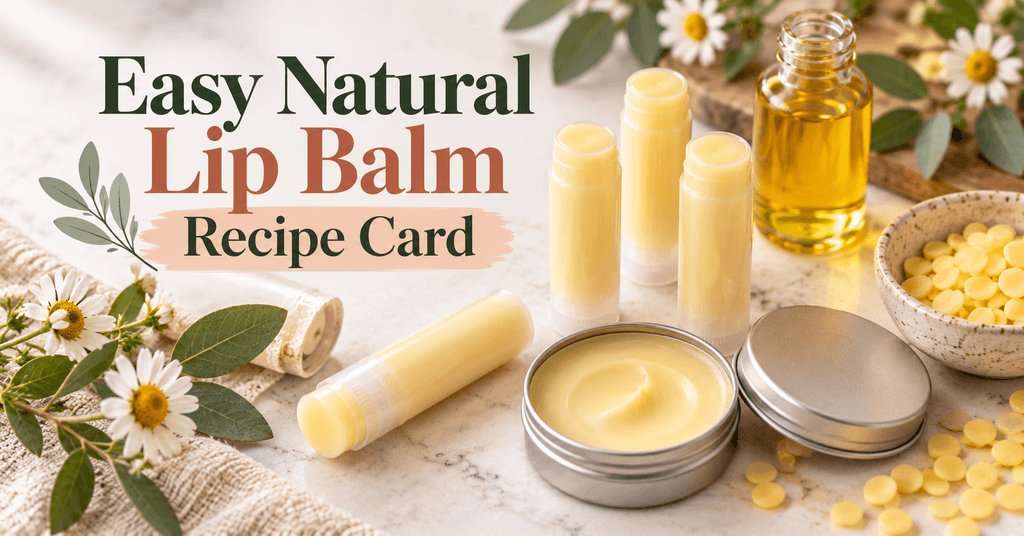
Yield: Depends on the capacity of your chosen tins or tubes
Ingredients
- 5 g beeswax
- 5 g shea butter
- 10 g jojoba oil
Method
- Weigh all ingredients.
- Melt gently in a double boiler.
- Stir until completely uniform.
- Perform a cold-plate texture test.
- Adjust with small measured additions of wax or oil if necessary.
- Pour into clean, dry containers.
- Allow to set completely.
- Cap and label with the batch date.
Conclusion
Once you understand how to make natural lip balm, the process comes down to balancing structure and softness rather than adding a long list of ingredients. Start with a simple water-free formula, measure in grams, use wax for firmness, and combine butter and liquid oil for texture and glide. Keep your first batch unscented, perform a cold-plate test, and adjust the formula in small measured steps. If you later add flavor, fragrance, color, or alternative waxes, use ingredients specifically suitable for lip products and follow their supplier and regulatory guidance.
FAQs
How do you make natural lip balm?
Melt a measured combination of wax, butter, and liquid oil, test the cooled texture, and pour it into clean, dry containers. A simple starting formula is 25% beeswax, 25% shea butter, and 50% jojoba oil by weight.
What are the best ingredients for natural lip balm?
A beginner-friendly formula needs a structural wax, an emollient butter, and a liquid oil. Beeswax, shea butter, and jojoba oil make a simple combination, but alternatives can work when the proportions are adjusted for their different textures.
What is the best beeswax-to-oil ratio for lip balm?
There is no universal ratio. A balanced starting formula is 25% beeswax, 25% butter, and 50% liquid oil. Softer tin balms can contain less wax, while a tube formula may need more.
Can you make lip balm with just beeswax and coconut oil?
Yes, but texture can vary considerably with temperature. Coconut oil becomes much softer as temperatures rise, so you will need to test the wax-to-oil ratio for your climate and packaging.
Can you make lip balm without beeswax?
Yes. Candelilla, carnauba, and other cosmetic-grade plant waxes can be used for vegan balm. They should not automatically be substituted for beeswax at the same percentage because their hardness and melting behavior differ.
Does homemade lip balm need a preservative?
A properly prepared water-free balm has much lower microbial risk than a water-based cosmetic, but water contamination should still be avoided. Adding water, aloe juice, fresh juice, or other aqueous ingredients changes the preservation requirements.
Does vitamin E preserve lip balm?
Not in the microbiological sense. Vitamin E is an antioxidant that can help slow oxidation of oils, but it is not a broad-spectrum antimicrobial preservative.
Can you put essential oils in lip balm?
Only if the exact essential oil is appropriate for leave-on lip use and is used within current supplier or IFRA limits. Essential oils vary in irritation, sensitization, and phototoxicity concerns, so there is no universal safe “number of drops.”
How long does homemade lip balm last?
There is no guaranteed shelf life. Fresh ingredients, oxidation stability, packaging, contamination, temperature, and light exposure all matter. Make small batches, date them, store them cool and dry, and discard balm that develops an unusual odor, color, or texture.
Read more: How to Make a Charcuterie Board: Easy Step-by-Step Guide
