
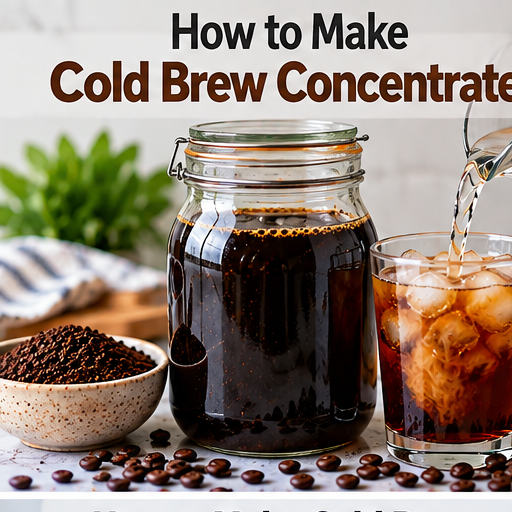

Learning how to make cold brew concentrate is mostly about getting four variables right: coffee-to-water ratio, grind size, steep time, and dilution. A reliable starting formula is 100 g (3.5 oz) coarse-ground coffee + 500 g (17.6 oz by weight) filtered water, a 1:5 coffee-to-water ratio by weight. Refrigerate for about 14–18 hours, strain thoroughly, and start serving it diluted 1 part concentrate to 1 part water or milk.
That 1:5 ratio is a strong, practical concentrate rather than a ready-to-drink cold brew.
Cold Brew Concentrate Recipe at a Glance
| Variable | Recommended Starting Point |
|---|---|
| Coffee | 100 g / 3.5 oz |
| Water | 500 g / 17.6 oz by weight, about 500 ml |
| Brewing ratio | 1:5 coffee : water by weight |
| Grind | Coarse |
| Steep time | 14–18 hours refrigerated |
| Filter | Fine-mesh sieve, then paper filter for extra clarity |
| Dilution | Start with 1 part concentrate + 1 part water or milk |
| Storage | Sealed container in refrigerator |
| Yield | Less than 500 ml because the coffee retains water |
For comparison, Mind Over Munch currently uses 4.5 oz coffee with 24 oz water, which works out to roughly the same neighborhood—about 1:5.3 coffee to water by weight. Stumptown also recommends 12 oz coffee with 64 oz water for homemade concentrate, again approximately 1:5.3 when water is treated by weight.
Ingredients
You only need:
- 100 g (3.5 oz) coffee beans, coarsely ground
- 500 g (500 ml / about 16.9 fl oz) filtered water
For serving, optionally use water, milk, plant milk, ice, simple syrup, or another flavoring.
What does a 1:5 ratio mean?
Throughout this recipe, ratios are written as:
coffee : water
So a 1:5 cold brew concentrate ratio means:
1 gram coffee for every 5 grams water.
For example:
100 g coffee + 500 g water
This distinction matters because some brewing guides write ratios in the opposite direction.
Equipment
No specialty cold-brew maker is necessary. A basic setup includes a kitchen scale, coffee grinder, large jar or pitcher, spoon, fine-mesh strainer, paper coffee filter or clean filter cloth, and a clean airtight storage container.
You can also use a French press, mason jar, or dedicated cold-brew brewer.
How to Make Cold Brew Concentrate
1. Weigh the coffee
Measure 100 g (3.5 oz) of coffee.
Using grams makes the recipe much easier to repeat and scale than measuring grounds by cups.
2. Grind the coffee coarse
Aim for a texture similar to coarse breadcrumbs or coarse sea salt—the general range used for French press coffee.
Avoid an espresso-like powder. Very fine coffee creates more fines, slows filtration, and can produce a muddy or harsher-tasting concentrate.
3. Add 500 g water
Place the coffee in your brewing container and add 500 g cool filtered water.
Because 1 ml of water weighs approximately 1 g for practical kitchen use, measuring 500 ml water is also convenient if your scale is unavailable.
4. Wet all the grounds
Stir gently until you no longer see large dry pockets.
You do not need aggressive agitation. The goal is simply to make sure the water reaches all the coffee.
5. Cover and refrigerate for 14–18 hours
Cover the container and place it in the refrigerator.
A 14–18 hour refrigerated steep is a useful starting range. Mind Over Munch gives a broader 12–24-hour window, while Stumptown’s French-press guidance uses a 16-hour steep.
6. Strain
Pour the brew through a fine-mesh strainer to remove the larger grounds.
For a cleaner concentrate, pass it through a paper coffee filter afterward. Avoid forcefully squeezing or pressing the grounds through the filter because that can add sediment.
7. Refrigerate the concentrate
Transfer the filtered coffee to a clean, sealed jar or bottle and refrigerate it.
8. Dilute before drinking
Begin with:
1 part concentrate + 1 part water or milk
Then taste it and adjust.
Counter Culture notes that concentrate-to-water dilution commonly falls between about 2:1 and 1:1, depending on the desired strength.
What Is the Best Cold Brew Concentrate Ratio?
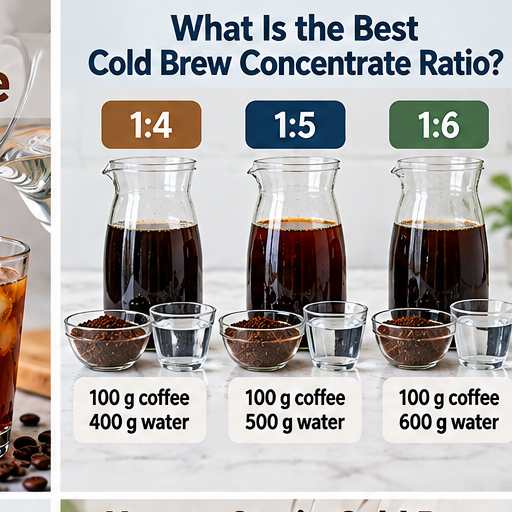
There is no single universally correct cold brew concentrate ratio. Different coffees, brewers, and serving styles work well at different strengths.
For home brewing, 1:5 coffee to water by weight is an easy starting point.
| Coffee : Water | Example | Result | Starting Dilution |
|---|---|---|---|
| 1:4 | 100 g + 400 g water | Very strong concentrate | 1:1 or more dilution |
| 1:5 | 100 g + 500 g water | Strong practical default | Start around 1:1 |
| 1:6 | 100 g + 600 g water | Slightly lighter concentrate | 1:0.5 to 1:1 |
The ratio should control the basic strength of your brew. Do not try to turn an overly weak recipe into concentrate simply by steeping it indefinitely.
Why Use a Scale Instead of Cups?
Coffee grounds do not have a fixed volume-to-weight conversion.
A cup of coffee can weigh differently depending on the bean, roast level, grind size, grinder, and how tightly the grounds are packed.
That makes 100 g coffee more repeatable than instructions such as “1½ cups coffee.”
A cup measurement can still work if that is all you have, but treat it as an approximation rather than an exact conversion.
What Grind Size Is Best?
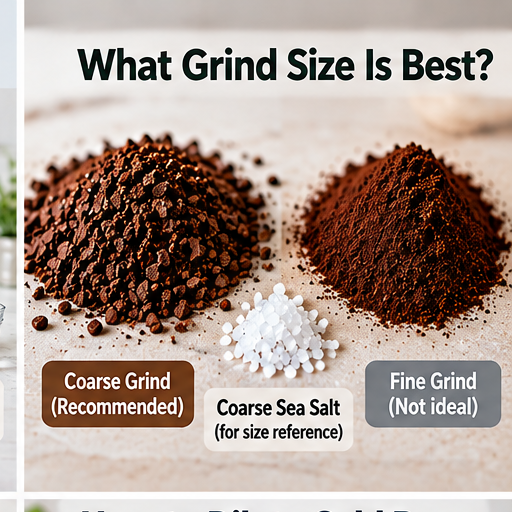
A coarse grind is usually the easiest choice for homemade cold brew concentrate.
Fine coffee creates more small particles that can pass through filters, making the concentrate cloudy or gritty. It can also alter extraction.
Extremely coarse coffee, however, can extract more slowly and may taste weak if combined with a short steep.
Think of grind, ratio, and time as separate controls rather than assuming one variable alone determines bitterness or strength.
What Coffee Beans Are Best for Cold Brew?
Almost any coffee can make cold brew, so choose according to the flavors you enjoy.
Medium and darker roasts often emphasize chocolate, caramel, nutty, and fuller-bodied characteristics.
Lighter roasts may preserve more fruit-forward, floral, or brighter notes.
Dark roast is therefore not automatically “better” for cold brew. Fresh whole beans ground shortly before brewing are useful when practical, but the roast style is primarily a matter of preference.
Should You Use Filtered Water?
Use clean water that tastes good on its own.
Water makes up almost the entire finished beverage, so unpleasant flavors can easily show through. Stumptown specifically recommends filtered water for home cold brewing.
How Long Should Cold Brew Concentrate Steep?
For this cold brew concentrate recipe, start with 14–18 hours in the refrigerator.
| Steep Time | What to Expect |
|---|---|
| 12 hours | Lighter extraction |
| 14–18 hours | Practical starting range |
| 18–24 hours | Deeper extraction; flavor may become harsher depending on coffee and grind |
| Beyond 24 hours | Usually unnecessary for most home batches |
Longer steeping does not make coffee endlessly stronger in a simple linear relationship. Extraction changes over time, and the easiest way to make a genuinely stronger concentrate is generally to adjust your coffee-to-water ratio.
Should Cold Brew Steep in the Fridge or on the Counter?
Both refrigerator and room-temperature cold brewing are used.
Refrigerator brewing extracts more slowly and makes the workflow simple because the coffee is already kept cold. This recipe therefore uses the refrigerator as the beginner-friendly default.
Room-temperature brewing can extract faster and may produce a different flavor profile.
Temperature, time, coffee, and ratio interact, so the exact steep time may need adjustment rather than applying one universal number to both methods.
How to Strain Cold Brew Concentrate
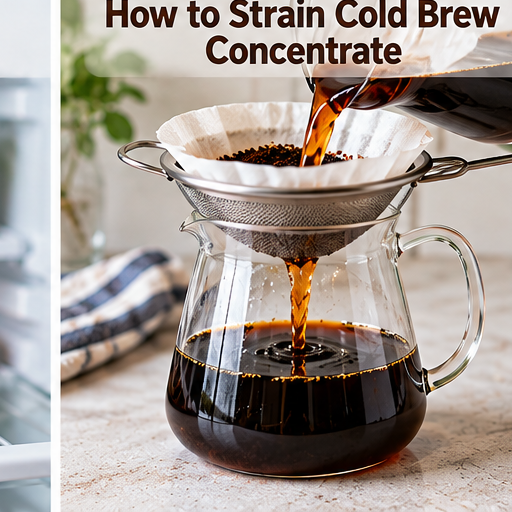
Filtration has a noticeable effect on texture.
For the cleanest cup, first remove the large grounds with a fine-mesh sieve and then pass the concentrate through a paper coffee filter.
For more body, use a cloth or reusable fiber filter.
Counter Culture explains that paper filtration removes more solids for greater clarity, while cloth or fiber-style filtration allows more oils and solids through and creates more texture.
How to Make Cold Brew Concentrate in a Mason Jar
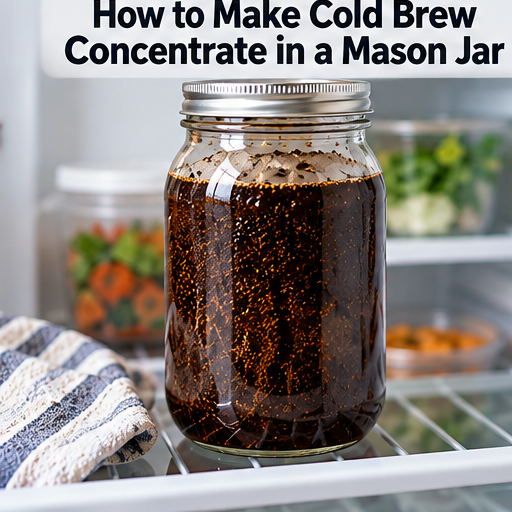
A mason jar works perfectly well.
Add 100 g coarse coffee and 500 g water to a jar large enough to leave some headroom. Stir gently, cover, refrigerate for 14–18 hours, then strain.
Choose a jar larger than the combined ingredient volume so stirring does not cause grounds or water to overflow.
How to Make Cold Brew Concentrate in a French Press
Use the same 1:5 coffee-to-water ratio.
Combine the coarse coffee and water in the French press but do not plunge immediately. Let the coffee steep, then push the plunger down slowly and decant the concentrate.
For extra clarity, run it through a paper coffee filter.
Stumptown specifically recommends a French press as an effective home cold-brew method and suggests paper filtering after the steep to remove fine particles.
How to Dilute Cold Brew Concentrate
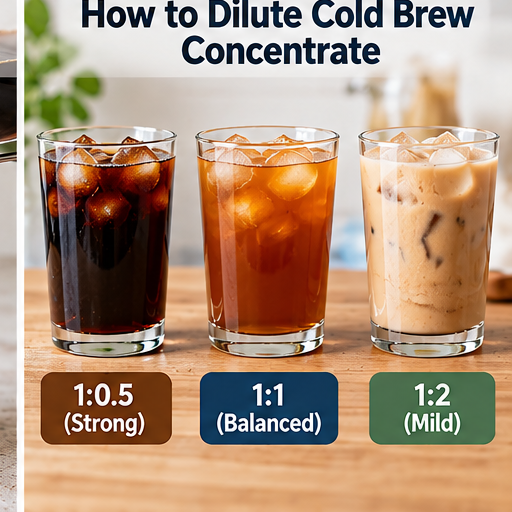
Start with:
1 part concentrate : 1 part water or milk
Then adjust according to the strength of your batch and how you plan to serve it.
| Concentrate : Diluent | Result |
|---|---|
| 1:0.5 | Strong |
| 1:1 | Balanced starting point |
| 1:1.5 | Lighter |
| 1:2 | Mild |
Remember that this is a serving dilution ratio, not the coffee-to-water brewing ratio.
Ice also melts into the drink, so a glass served over plenty of ice may need less added water.
How to Make Iced Coffee From Cold Brew Concentrate
Try:
4 oz concentrate + 4 oz cold water + ice
Or for a milk-based drink:
4 oz concentrate + 4 oz milk + ice
Treat these amounts as starting points rather than fixed rules.
Cold brew is not the same process as brewing coffee hot and cooling it over ice.
Can You Make Hot Coffee With Cold Brew Concentrate?
Yes.
Start with:
1 part cold brew concentrate + 1 part hot water
Adjust from there.
Heating the dilution water rather than aggressively boiling the concentrate lets you make a warm drink while preserving the convenience of your prepared coffee base.
Cold Brew vs. Cold Brew Concentrate
| Feature | Cold Brew | Cold Brew Concentrate |
|---|---|---|
| Coffee-to-water ratio | Generally more water | More coffee relative to water |
| Strength | Often ready to drink | Intentionally strong |
| Dilution required | Usually little or none | Usually yes |
| Storage space | More | Less |
| Serving flexibility | Moderate | High |
| Typical use | Drink directly | Base for water, milk, hot or iced drinks |
There is no legally standardized brewing ratio that universally separates “cold brew” from “cold brew concentrate.” In practical terms, concentrate simply means the coffee is brewed strongly enough that dilution is expected.
How Much Concentrate Will This Recipe Make?
Do not expect 500 ml water to produce 500 ml concentrate.
Ground coffee absorbs and retains part of the brewing water. The final yield also changes with grind, filtration method, draining time, and whether pressure is applied to the grounds.
For that reason, the starting water volume is much easier to standardize than the final liquid yield.
How Long Does Cold Brew Concentrate Last?
For home use, aim to enjoy refrigerated concentrate while its flavor is fresh—roughly within 7–10 days is a practical quality target.
Some coffee guidance extends refrigerated undiluted concentrate toward approximately two weeks, but storage conditions vary. Keep it cold in a clean, tightly sealed container.
Discard it if you notice mold, unexpected fermentation or fizzing, or other abnormal changes. Smell alone should not be treated as a guarantee of food safety.
Once milk or another perishable ingredient is added, follow that ingredient’s refrigerated storage guidance and consume the mixed drink much sooner.
Should You Dilute the Whole Batch Before Storing?
Usually, no.
Store the concentrate undiluted and dilute individual servings.
That gives you more flexibility, uses less refrigerator space, and allows one person to make a stronger glass while another makes a lighter one.
Is Cold Brew Less Acidic Than Hot Coffee?
The science is more nuanced than saying cold brew is simply “much less acidic.”
A peer-reviewed study comparing hot- and cold-brew coffee found comparable pH values, around 4.85–5.13 for the coffees tested, while other measurements of acidity differed between brewing methods.
pH measures hydrogen-ion activity, while titratable acidity measures the quantity of acid that can react during titration. They describe related but different properties.
Roast, origin, temperature, and brewing conditions also affect coffee chemistry, so cold brew should not be promoted as a treatment for reflux, GERD, or other medical conditions.
Does Cold Brew Concentrate Have More Caffeine?
Cold brew concentrate uses more coffee relative to brewing water than many ready-to-drink recipes, but that does not give every glass a predictable caffeine amount.
Caffeine per serving depends on coffee variety, dose, grind, extraction, steep conditions, serving size, and—critically—how much you dilute the concentrate.
Without laboratory measurement or specific validated product data, a universal caffeine number would be misleading.
Common Cold Brew Concentrate Mistakes
Common problems include using an unnecessarily fine grind, estimating coffee instead of weighing it, using too little coffee for a concentrate, trying to correct a weak ratio by steeping indefinitely, leaving dry pockets of coffee, squeezing fines through the filter, using unpleasant-tasting water, assuming all starting water becomes finished concentrate, forgetting to dilute a strong batch, and storing the finished coffee uncovered.
Why Is My Cold Brew Bitter?
Possible causes include an overly fine grind, very dark-roasted coffee, excessive extraction for that particular coffee, high agitation, excessive fine sediment, or simply drinking a concentrated brew with too little dilution.
Change one variable at a time so you can identify what improves the next batch.
Why Is My Cold Brew Weak or Watery?
Check whether you used too much brewing water, too little coffee, an extremely coarse grind, an unusually short steep, or too much water during serving.
The simplest next-batch correction is often a stronger brewing ratio rather than adding many more hours to the steep.
Why Is My Cold Brew Cloudy or Muddy?
Fine coffee particles are usually responsible.
Try a coarser grind, pass the concentrate through a paper filter, or perform a second filtration.
Cloudiness is often a texture and clarity issue rather than, by itself, evidence that the coffee is unsafe.
Cold Brew Concentrate Ratio Calculator / Batch Table
The table below uses the 1:5 coffee : water default.
| Coffee | 1:4 Water | 1:5 Water | 1:6 Water |
|---|---|---|---|
| 50 g | 200 g | 250 g | 300 g |
| 75 g | 300 g | 375 g | 450 g |
| 100 g | 400 g | 500 g | 600 g |
| 150 g | 600 g | 750 g | 900 g |
| 200 g | 800 g | 1,000 g | 1,200 g |
| 250 g | 1,000 g | 1,250 g | 1,500 g |
How to Scale the Recipe
For a 1:5 coffee-to-water ratio:
Coffee weight × 5 = water weight
Example:
200 g coffee × 5 = 1,000 g water
Or, if you already know how much water you want to use:
Water weight ÷ 5 = coffee weight
Example:
1,000 g water ÷ 5 = 200 g coffee
For practical kitchen measurements, 1 ml water ≈ 1 g water.
Cold Brew Coffee Concentrate Recipe Card
Prep time: 5–10 minutes
Steep time: 14–18 hours
Brewing ratio: 1:5 coffee : water by weight
Ingredients
- 100 g (3.5 oz) coarse-ground coffee
- 500 g (500 ml) filtered water
Method
- Place the coarse-ground coffee in a large jar or pitcher.
- Add 500 g filtered water.
- Stir gently until all grounds are wet.
- Cover and refrigerate for 14–18 hours.
- Strain through a fine-mesh sieve.
- Paper-filter if you prefer a cleaner concentrate.
- Transfer to a clean sealed container and refrigerate.
- Start serving at approximately 1 part concentrate to 1 part water or milk, then adjust.
Scaling: Multiply coffee weight by 5 to determine water weight.
Storage: Keep refrigerated and sealed. For best flavor, aim to use the concentrate within roughly 7–10 days.
Frequently Asked Questions
What is the best ratio for cold brew concentrate?
A useful starting ratio is 1:5 coffee to water by weight, meaning 100 g coffee to 500 g water. A 1:4 ratio produces a stronger concentrate, while 1:6 is somewhat lighter. There is no universal ratio because coffee, equipment, and serving preferences vary.
How do you make cold brew concentrate?
Combine coarse-ground coffee and cold filtered water at about a 1:5 coffee-to-water ratio by weight. Refrigerate for roughly 14–18 hours, strain thoroughly, transfer to a sealed container, and dilute each serving with water or milk.
Is 12 hours enough for cold brew?
It can be. A 12-hour steep may create a lighter extraction, particularly when brewing in the refrigerator. If the result tastes underdeveloped, try 14–18 hours next time before changing several variables simultaneously.
Can you steep cold brew for 24 hours?
Many recipes use a range extending to 24 hours, including Mind Over Munch’s current 12–24-hour guidance. Longer is not automatically better, however, and a very long steep may produce flavors you find woody or harsh depending on the coffee and grind.
Do you make cold brew concentrate in the fridge?
You can brew in either the refrigerator or at room temperature. Refrigerator extraction tends to proceed more slowly, so this recipe recommends 14–18 refrigerated hours as a simple, consistent starting workflow.
Can I use regular ground coffee for cold brew?
You can, but typical pre-ground coffee may be finer than ideal. It can create more sediment and make filtration slower. A coarse grind is generally easier to strain and troubleshoot.
Why should cold brew coffee be ground coarse?
Coarse grounds make filtration easier and reduce the amount of fine sediment entering the concentrate. Grind size also affects extraction, so an extremely coarse grind may need adjustment in steep time or brewing ratio.
How do you dilute cold brew concentrate?
Start with 1 part concentrate and 1 part water or milk. For a stronger serving, try 1:0.5. For a lighter drink, use 1:1.5 or 1:2. Ice melt should also be considered.
How long does cold brew concentrate last?
For quality, a useful home target is around 7–10 days refrigerated in a clean, sealed container. Some guides extend undiluted concentrate toward two weeks, but cleanliness, filtration, refrigeration, and added ingredients affect storage.
Can I make cold brew concentrate in a French press?
Yes. Combine coarse coffee and water without immediately plunging, let it steep, press slowly, and decant it off the grounds. For greater clarity, pass the concentrate through a paper filter afterward. Stumptown specifically recommends French press as a home cold-brew option.
Conclusion
The easiest way to learn how to make cold brew concentrate is to keep the variables simple. Start with a 1:5 coffee-to-water ratio by weight, use coarse coffee, refrigerate for about 14–18 hours, strain thoroughly, and dilute the concentrate to taste.
If the next batch needs adjustment, change one variable at a time. Use the brewing ratio to make the concentrate stronger or lighter, grind and steep time to refine extraction, and the serving dilution to control the final drink.
