
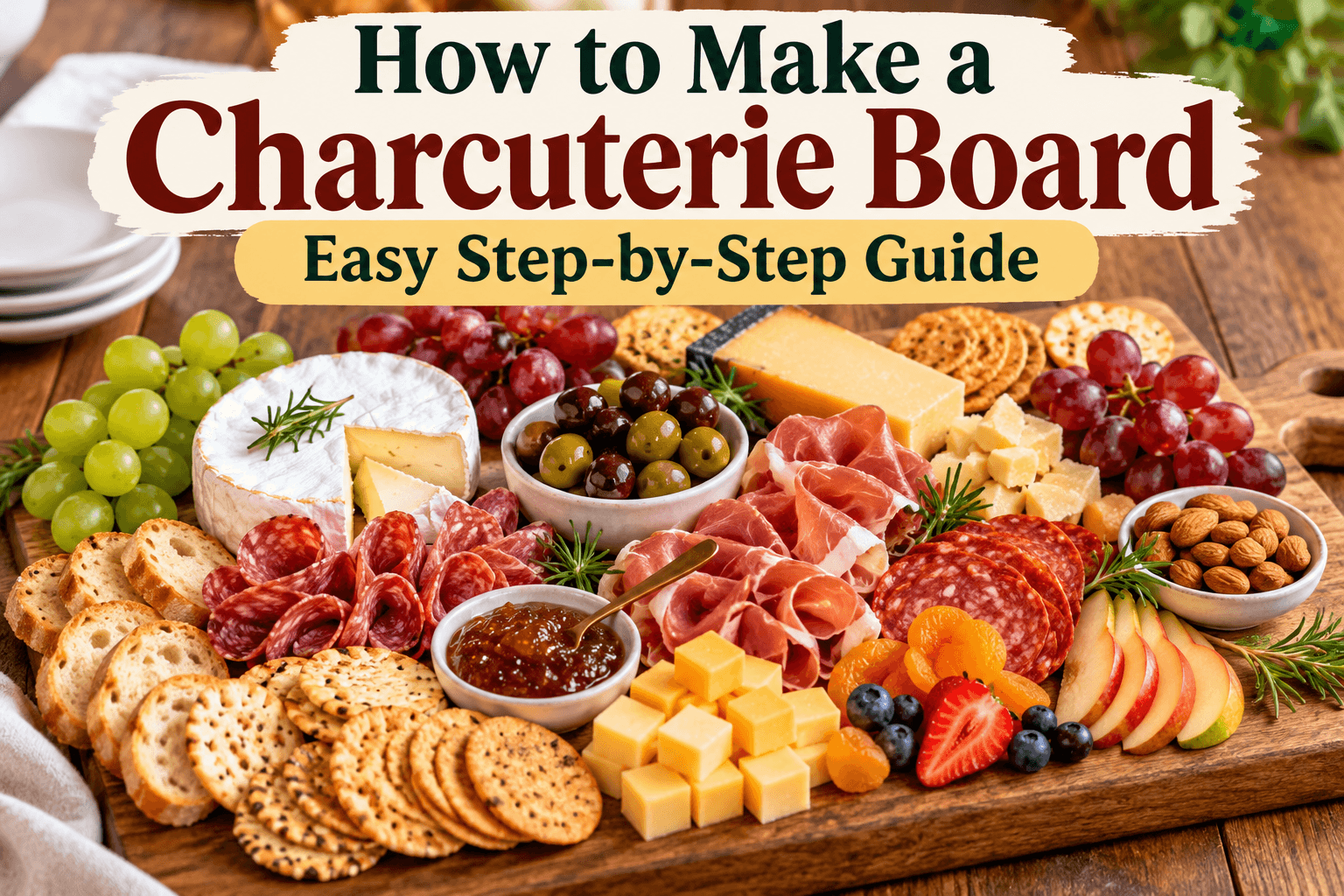

Learning how to make a charcuterie board is easier when you stop thinking of it as a decorating project and start with a simple food formula. For most gatherings, combine two or three cheeses, two or three cured meats, crackers or bread, fresh fruit, something briny, something sweet, and one crunchy extra.
The key is contrast rather than quantity: creamy and firm cheese, delicate and hearty meat, sweet fruit, salty pickles, and crisp crackers. Start with bowls and larger ingredients, then fill smaller spaces. That gives you an abundant-looking board without buying more food than you need.
The Easiest Charcuterie Board Formula
For a beginner-friendly board, use this flexible formula:
- 2–3 cheeses
- 2–3 meats
- 2 cracker or bread options
- 2 fruits or vegetables
- 1 briny item
- 1 sweet item
- 1 crunchy item
- 1 spread
For a small board serving two to four people, two cheeses and two meats can be plenty. For a larger gathering, add more variety rather than buying a huge amount of every ingredient.
This approach is intentionally more flexible than a fixed “3-3-3” formula. Sugar Geek Show uses that easy-to-remember method, but smaller gatherings do not necessarily need nine separate products.
What Is a Charcuterie Board?
Technically, charcuterie refers to prepared meats, including cured, smoked, cooked, or preserved meats. Modern American-style charcuterie boards have expanded into grazing platters containing meats, cheeses, crackers, bread, fruit, nuts, olives, pickles, jams, honey, and other accompaniments. The Kitchn similarly notes that modern charcuterie boards have evolved into broader appetizer or grazing boards.
A completely meat-free version is more precisely called a cheese board, grazing board, or snack board, although “vegetarian charcuterie board” is now widely used as a search and menu term.
Charcuterie Board Shopping List
You do not need everything below. Choose ingredients that provide different textures, flavors, and colors.
| Category | Good Choices |
| Soft cheese | Brie, Camembert, goat cheese |
| Semi-soft cheese | Havarti, fontina |
| Firm cheese | Cheddar, manchego, Gouda |
| Hard cheese | Parmesan, aged Gouda |
| Blue cheese | Gorgonzola, Stilton |
| Delicate meat | Prosciutto |
| Firm meat | Salami, soppressata, summer sausage |
| Rich meat | Mortadella |
| Lean/intense meat | Bresaola |
| Crackers/bread | Plain crackers, seeded crackers, baguette, crostini, breadsticks |
| Fresh fruit | Grapes, berries, apples, pears, figs |
| Dried fruit | Apricots, dates, cranberries |
| Briny/acidic | Olives, cornichons, pickles, marinated vegetables |
| Sweet | Honey, fig jam, fruit preserves, quince paste |
| Crunchy | Nuts, pretzels, crisp crackers |
| Optional | Dark chocolate, vegetables, fresh herbs |
A beginner board normally needs only two to four cheeses, not one cheese from every category.
How Much Meat and Cheese Do You Need Per Person?
There is no single industry rule because quantities depend on whether the board is a light appetizer or the main food.
Food Network currently recommends approximately 2–3 ounces of meat and about 3 ounces of cheese per person for an appetizer-style board, while other cheese specialists commonly use smaller appetizer portions. Murray’s, for example, has published guidance of roughly 1–2 ounces of cheese per person for an appetizer spread.
For home entertaining, this practical planning range works well:
Appetizer Board
Plan approximately:
- Meat: 1.5–2.5 ounces per person
- Cheese: 1.5–2.5 ounces per person
Use the lower end when dinner follows soon and there are other appetizers. Use the upper end for a longer cocktail period or a substantial grazing spread.
Charcuterie as the Main Food
Increase the combined meat and cheese considerably—roughly 5–7 ounces of meat and cheese per person combined is a useful starting point—then provide generous bread, fruit, vegetables, and other accompaniments.
These figures are planning guidance, not a food-service rule. Appetite, party duration, and the amount of other food matter.
Charcuterie Board Amounts by Guest Count
The table below uses a comfortable appetizer target of about 2 ounces each of meat and cheese per guest, rounded into practical shopping quantities.
| Guests | Cheese | Meat | Crackers/Bread | Fruit | Cheese Varieties | Meat Varieties | Suggested Board |
| 4 | 8 oz | 8 oz | 1 box or small baguette | 1–2 cups | 2 | 2 | 8–12 in. platter |
| 6 | 12 oz | 12 oz | 1–2 boxes / 1 baguette | 2–3 cups | 2–3 | 2–3 | Medium board |
| 8 | 1 lb | 1 lb | 2 boxes / 1 baguette | 3–4 cups | 3 | 3 | About 12×18 in. |
| 10 | 1¼ lb | 1¼ lb | 2–3 boxes / 1–2 baguettes | 4–5 cups | 3–4 | 3–4 | Large board |
| 12 | 1½ lb | 1½ lb | 3 boxes / 2 baguettes | 5–6 cups | 3–4 | 3–4 | Large board |
| 20 | 2½ lb | 2½ lb | 4–5 boxes / 3 baguettes | 8–10 cups | 4–5 | 4–5 | Multiple boards |
Keep extra crackers or sliced bread nearby instead of trying to fit every piece on the board. Food Network specifically emphasizes having plenty of bread or crackers available.
What Size Charcuterie Board Do You Need?
Exact dimensions matter less than the amount and style of food, but these ranges are practical:
2–4 people: an 8- to 12-inch platter or small cutting board.
4–6 people: a medium cutting board. Food Network identifies a standard board around 12×18 inches as suitable for roughly four to six people.
8–10 people: a large platter or serving board, roughly 12×18 inches or larger depending on how much stays off-board.
More than 10–12 people: consider two or more boards. Multiple smaller boards are easier to refill, reach, and keep looking organized than one enormous platter.
Which Cheeses Should You Choose?
Choose cheese by contrast instead of buying as many varieties as possible.
A reliable three-cheese combination is:
One soft: Brie or Camembert.
One firm: aged cheddar, Gouda, or manchego.
One bold or different: goat cheese, blue cheese, smoked Gouda, or Parmesan.
Variation can come from texture, milk type, or intensity. Expensive artisan cheese is optional. A familiar cheddar beside a smaller wedge of premium cheese can provide just as much contrast.
How Much Cheese Variety Is Enough?
For 2–4 guests, two cheeses can be enough.
For 6–8 guests, three cheeses usually provide good variety.
For a larger group, three to five cheeses is normally enough, especially when meat and accompaniments are plentiful.
More varieties do not automatically make the board better. Contrast matters more.
Best Meats for a Charcuterie Board
Choose meats that provide different textures.
Prosciutto: delicate, thin, salty, and easy to ribbon.
Salami: firm, familiar, and easy to fold or fan.
Soppressata: firmer and often more strongly seasoned.
Summer sausage: substantial and beginner-friendly.
Mortadella: soft and rich.
Bresaola: leaner and more intensely flavored.
Two or three contrasting meats will generally create a more interesting board than several similar salamis.
Easy Cheese and Meat Pairings
These combinations are suggestions rather than rules.
| Cheese | Meat | Accompaniment |
| Brie | Prosciutto | Fig jam |
| Manchego | Salami | Olives |
| Cheddar | Summer sausage | Mustard |
| Goat cheese | Prosciutto | Honey |
| Parmesan | Soppressata | Dried apricot |
| Blue cheese | Prosciutto | Pear or honey |
Crackers and Bread: How Much Do You Need?
Crackers frequently disappear faster than meat or cheese because guests use them as a base for multiple bites.
Offer at least two textures when possible—for example, one plain cracker plus baguette slices or a seeded cracker.
Do not overcrowd the board with them. Place a few attractive stacks or fans on the platter and keep a basket or bowl of extra crackers nearby. Both Food Network and The Kitchn recommend keeping generous bread/cracker supplies while allowing extras to remain off the main board.
How to Make a Charcuterie Board Step by Step
1. Choose a Food-Safe Board
Use a clean wooden cutting board, food-safe slate or stone surface, ceramic platter, large plate, or even a sheet pan.
The board does not need to be expensive.
2. Place Bowls First
Add small bowls for olives, cornichons, mustard, honey, jam, or other wet ingredients.
Bowls create visual anchors and prevent liquids from making crackers soggy.
3. Position the Cheeses
Space cheeses across the board rather than putting all of them together.
Pre-cut at least part of firm cheeses so guests immediately understand how to serve themselves.
4. Add the Meats
Fold salami, loosely ribbon prosciutto, or fan sausage slices.
Avoid leaving thin meats in flat package-like stacks. Small clusters are easier to grab and create more visual height.
5. Add Crackers and Bread
Create short fans or stacks around the board.
Keep additional crackers nearby for refilling.
6. Add Fruit and Vegetables
Use grapes, berries, apple or pear slices, figs, cucumber, or other fresh ingredients to break up large sections of beige and brown food.
7. Add Briny and Sweet Ingredients
Place pickles, olives, honey, mustard, or jam close to foods they complement.
8. Fill Small Gaps
Use inexpensive small ingredients such as dried fruit, berries, nuts, small pickles, or chocolate.
9. Add Serving Utensils
Depending on the board, include cheese knives, small forks, spreaders, spoons, or tongs.
10. Check It From a Guest’s Perspective
Make sure everything is easy to reach, identify, cut, spread, and pick up.
A practical board is better than a beautiful platter that nobody can comfortably eat.
The general large-to-small assembly method also aligns with current guidance from Sugar Geek Show and The Kitchn, both of which start with bowls or major anchors before filling smaller spaces.
The Secret to Making a Charcuterie Board Look Full
Professional-looking boards rely more on arrangement than expensive ingredients.
Use clusters instead of scattering individual pieces everywhere.
Use fans for crackers and sliced cheese.
Use folds and ribbons for meat.
Create height with bowls and cheese wedges.
Repeat an ingredient in two smaller locations if one large pile looks awkward.
Use color contrast from grapes, berries, dried apricots, olives, pickles, or vegetables.
Finally, fill narrow spaces with smaller foods.
The goal is controlled abundance—not random overcrowding.
How to Fold Meat for a Charcuterie Board
For salami, fold each round in half, or fold it again into quarters for extra height.
For prosciutto, loosely gather or ribbon each slice rather than compressing it.
For summer sausage or other firm sliced meats, overlap the rounds into a fan.
A salami rose can be attractive, but it is optional. Easy-to-eat folds are more important than social-media styling tricks.
How to Cut Cheese for a Charcuterie Board
Soft wheel: leave mostly whole and cut one starter wedge.
Firm block: slice into triangles, rectangles, or cubes.
Hard cheese: cut into rustic chunks or thin shards.
Cheese log: slice into rounds.
Crumbly cheese: break naturally into bite-size pieces.
Different shapes create visual interest while also making cheese easier to serve.
How to Build a Small Charcuterie Board
For two to four people, keep it simple:
- 2 cheeses
- 2 meats
- 1 cracker
- 1 fruit
- Olives or cornichons
- 1 jam or honey
- A small handful of nuts or another crunchy filler
A small board does not need three cheeses, three meats, and three accompaniments. Using fewer categories in appropriate quantities keeps it full-looking without unnecessary leftovers.
Charcuterie Board for 8–10 People
For an appetizer board, try:
- About 1–1¼ pounds cheese total
- About 1–1¼ pounds cured meat total
- 3 cheeses
- 3 meats
- 2 cracker/bread options
- 3–5 cups fresh fruit
- 1 bowl olives or cornichons
- 1–2 spreads
- 1 crunchy extra
A simple combination could be Brie, cheddar, manchego, prosciutto, salami, soppressata, plain crackers, baguette, grapes, apples, olives, fig jam, and almonds.
How to Make a Charcuterie Board on a Budget
A budget charcuterie board can still look generous.
Use two cheeses instead of five. Choose one premium cheese plus an inexpensive crowd-pleaser such as cheddar. Buy sliced meat by the weight you actually need instead of automatically purchasing several large packages.
Use baguette as one of the carb options, choose seasonal fruit, and check your pantry for jam, honey, nuts, mustard, or pickles.
Vegetables and fruit are useful for filling visual space without adding more expensive meat and cheese.
Low-Cost Approach
Two cheeses, two meats, baguette, seasonal fruit, pickles, and one pantry spread.
Mid-Range Approach
Three cheeses, three meats, crackers plus bread, two fruits, olives, jam, and nuts.
Splurge Approach
Use the same basic structure but make one or two premium cheeses or specialty meats the focal ingredients rather than upgrading every item.
Can You Make a Charcuterie Board Ahead of Time?
Yes, but assemble it in stages.
The Day Before
Buy ingredients, portion nuts, prepare dips, pre-cut suitable firm cheeses, organize containers, and wash and thoroughly dry sturdy produce.
A Few Hours Before
Arrange the cheese, meats, and bowls. Cover the board well and refrigerate it.
Just Before Serving
Add crackers, bread, delicate fruit, herbs, and other ingredients that can become soft or soggy.
The Kitchn likewise recommends preparing ingredients before building the board and scaling the food to fit the available serving surface.
How Long Can a Charcuterie Board Sit Out?
This is where food safety matters more than styling.
USDA/FSIS advises that perishable food should not remain unrefrigerated for more than 2 hours. When the temperature is above 90°F (32°C), that limit drops to 1 hour.
Charcuterie commonly contains perishable foods such as meat and dairy. USDA identifies meat and dairy products among foods that require refrigeration for safety.
For a long event, put out smaller portions and replenish them from refrigerated backup rather than placing everything out at once.
USDA recommends keeping the refrigerator at 40°F (about 4°C) or below.
Should Cheese Come to Room Temperature?
Some cheeses become more aromatic and flavorful as they lose their refrigerator chill, but culinary preference should not override food-safety limits.
Avoid interpreting “serve cheese closer to room temperature” as permission to leave an entire meat-and-cheese board sitting out indefinitely. Keep the overall USDA time and temperature rules in mind.
How to Store Leftovers
Separate meat, cheese, fruit, crackers, and wet accompaniments when practical.
Refrigerate safe perishable leftovers promptly. Store crackers and bread separately so they remain dry.
Do not save perishable meat, cheese, or other foods that have exceeded safe room-temperature limits. Odor and appearance alone cannot reliably tell you whether harmful bacterial growth has occurred.
Vegetarian Charcuterie Board
Technically, this is better described as a cheese or grazing board, but the commonly searched term “vegetarian charcuterie board” is useful.
Replace meat with ingredients such as:
- Additional contrasting cheeses
- Hummus
- Marinated vegetables
- Olives
- Roasted nuts
- Stuffed peppers
- Fruit
- Crackers
- Plant-based alternatives
Gluten-Free Charcuterie Board
Use certified gluten-free crackers plus naturally suitable fruits and vegetables.
Check labels on processed meats, spreads, sauces, seasonings, and other packaged foods instead of assuming they are gluten-free.
For guests with celiac disease, also manage cross-contact. Separate boards and utensils can make the setup easier.
Nut-Free Charcuterie Board
Replace nuts with extra fruit, vegetables, crackers, seeds where appropriate, or allergen-safe pretzels.
When serving someone with a true food allergy, read package labels and cross-contact warnings. Simply removing visible nuts is not always sufficient.
Common Charcuterie Board Mistakes
Buying too many varieties: Buy enough of fewer ingredients instead.
Running out of crackers: Keep refills beside the board.
Leaving every cheese as a large block: Pre-cut at least part of firm cheeses.
Putting wet foods directly beside crackers: Use bowls for olives, pickles, honey, and jam.
Using a board that is too large: Move ingredients closer together or use a smaller board.
Overcrowding: Move extra bread, crackers, or fruit to separate serving dishes.
Using only rich, salty ingredients: Add fruit, pickles, mustard, or other fresh and acidic elements.
Forgetting utensils: Include knives, spoons, forks, or tongs as needed.
Ignoring allergies: Check labels and use separate serving tools or boards where appropriate.
Leaving food out too long: Follow USDA time-and-temperature guidance.
What If Your Board Looks Empty?
Do not immediately buy more meat and cheese.
Fill gaps with grapes, baguette slices, crackers, berries, dried fruit, olives, vegetables, or nuts when suitable.
You can also move clusters closer together. A slightly smaller arrangement often looks more abundant than the same amount of food spread across a huge platter.
What If Your Board Is Too Crowded?
Move bread, crackers, and extra fruit to bowls or plates beside the main board.
This often makes the centerpiece easier to eat while creating room around cheeses, meats, and spreads.
Everything does not have to fit on one surface.
Charcuterie Board Flavor Formula
| Flavor or Texture | Examples |
| Rich | Brie, salami |
| Salty | Prosciutto, olives |
| Sweet | Fruit, honey, jam |
| Acidic | Pickles, mustard |
| Crunchy | Crackers, nuts |
| Creamy | Brie, goat cheese |
| Fresh | Grapes, pears, vegetables |
A board feels balanced when guests can create contrasting bites rather than simply choosing between many similar rich ingredients.
Easy Charcuterie Board Recipe
Yield: About 8 appetizer servings
Prep time: About 25 minutes
Cheeses
- 6 oz Brie
- 5 oz aged cheddar
- 5 oz manchego
Meats
- 5 oz prosciutto
- 6 oz salami
- 5 oz soppressata
Crackers and Bread
- 1 box plain or lightly seasoned crackers
- 1 small baguette, sliced
Fruit
- 2 cups seedless grapes
- 1 apple or pear, sliced shortly before serving
Briny Item
- ¾ cup olives or cornichons
Sweet Spread
- ⅓ cup fig jam or honey
Crunchy Extra
- ¾ cup almonds or another suitable crunchy ingredient
Instructions
- Place the jam and olives in small bowls and position them on the serving board.
- Add the Brie, cheddar, and manchego in separate areas.
- Fold or ribbon the meats and place them between the cheeses.
- Add several small stacks of crackers and baguette.
- Add grapes and sliced apple or pear.
- Fill narrow spaces with almonds.
- Add cheese knives, spoons, and small tongs as needed.
- Keep extra crackers and bread beside the board.
- Refrigerate perishable ingredients until close to serving time and follow USDA’s two-hour rule once perishable food is out.
Frequently Asked Questions
What goes on a charcuterie board?
A modern charcuterie board usually contains cured meats, cheeses, bread or crackers, fresh or dried fruit, something briny such as olives or pickles, something sweet such as honey or jam, and a crunchy element such as nuts. You can adjust the categories to suit the number of guests.
How do you make a charcuterie board step by step?
Place bowls first, arrange cheeses around them, add folded or fanned meats, then add crackers and bread. Next add fruit, pickles, and sweet accompaniments. Finish with small fillers such as berries, nuts, or dried fruit and add appropriate serving utensils.
What are the main components of a charcuterie board?
The core is charcuterie—prepared or cured meat—plus cheese and a bread or cracker component. Modern boards commonly expand those basics with fruit, nuts, pickles, olives, spreads, and sweet ingredients.
What cheeses are best for a charcuterie board?
Choose contrasting cheeses rather than one specific list. A simple combination is a soft cheese such as Brie, a firm cheese such as cheddar or manchego, and a different or stronger option such as goat cheese, Parmesan, blue cheese, or smoked Gouda.
What meats are best for a charcuterie board?
Prosciutto, salami, soppressata, mortadella, bresaola, and summer sausage all work well. For a beginner board, choose two or three meats with noticeably different textures rather than several similar salamis.
How much meat and cheese do I need per person?
For an appetizer, roughly 1.5–2.5 ounces each of meat and cheese per person is a useful home-entertaining range. Use less when dinner follows soon and more for a substantial grazing spread. Current culinary recommendations vary, so treat these amounts as planning guidance rather than fixed rules.
What do you put on a charcuterie board first?
Start with bowls containing wet or loose foods such as olives, pickles, honey, jam, or mustard. Then add cheeses and other large anchor ingredients before working toward meats, crackers, fruit, and small fillers.
How far ahead can I make a charcuterie board?
You can prep many components the day before and arrange refrigerated meat and cheese several hours before serving. Keep the board covered and chilled. Add crackers, bread, delicate fruit, and anything likely to become soggy shortly before serving.
How long can a charcuterie board sit out?
USDA says perishable food should not stay unrefrigerated for more than two hours, or more than one hour when the temperature is above 90°F/32°C. For long parties, serve smaller portions and replenish them from the refrigerator.
How do you make a cheap charcuterie board look full?
Use fewer varieties, inexpensive crackers or baguette, seasonal fruit, vegetables, olives, pantry spreads, and small fillers. Arrange ingredients in compact clusters and reserve premium meat or cheese for a few focal areas rather than buying large quantities of everything.
Conclusion
Once you understand how to make a charcuterie board, you do not need an elaborate shopping cart or restaurant-level styling skills. Choose a few contrasting meats and cheeses, add bread or crackers, balance rich foods with fresh, sweet, briny, acidic, and crunchy ingredients, and arrange everything from large anchors to smaller fillers.
Keep extra crackers nearby, use bowls for wet foods, and avoid buying more varieties than your guest count requires. Most importantly, keep perishable ingredients appropriately refrigerated and respect USDA serving-time limits.
Read more: How to Make Cold Brew Concentrate: Easy Ratio & Recipe

1 Comment
Pingback: How to Make Baked Macaroni and Cheese: Easy Recipe Copy Title