
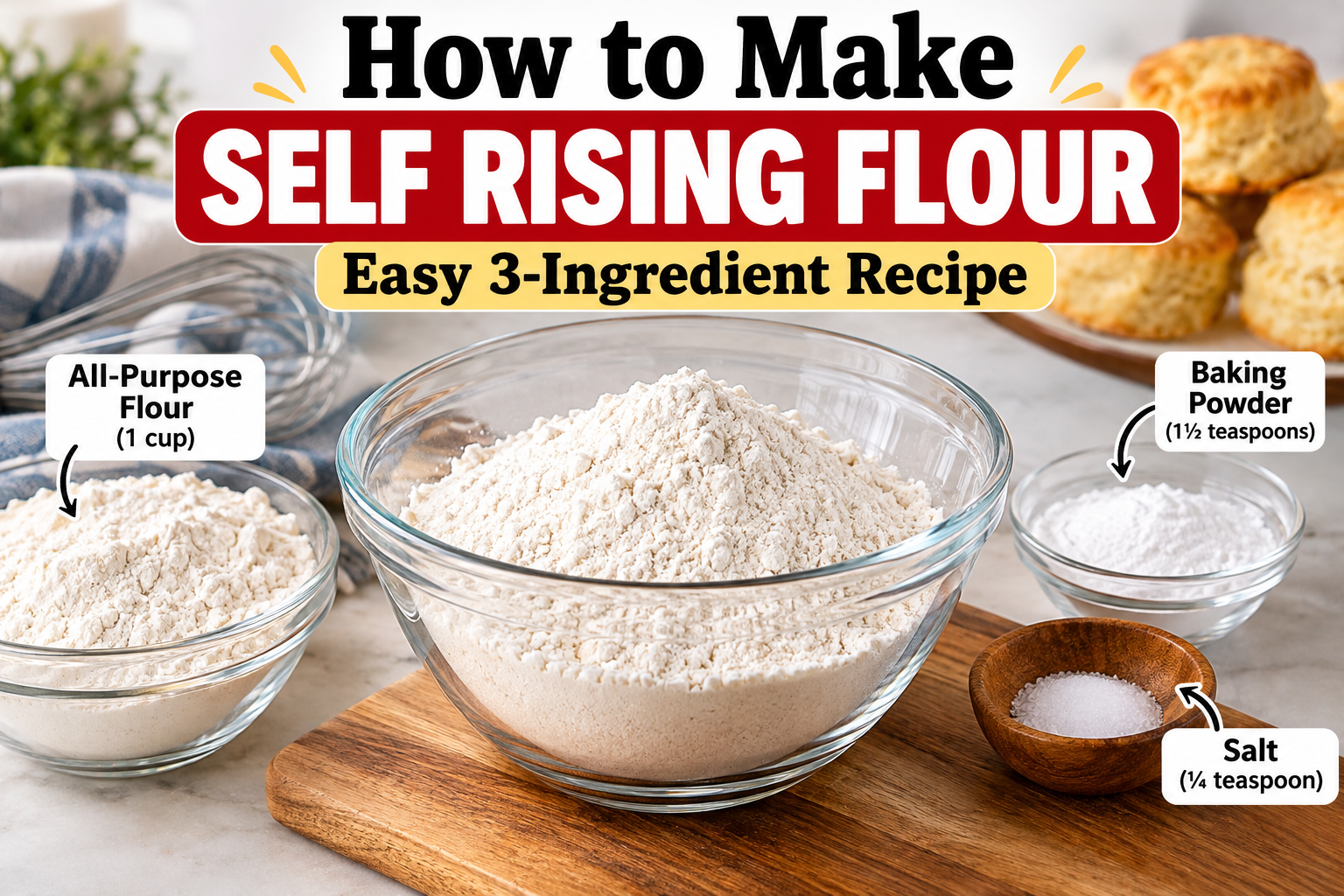

Learning how to make self rising flour is simple when you have three basic pantry ingredients. Combine 1 cup (120 g) all-purpose flour, 1½ teaspoons baking powder, and ¼ teaspoon fine table salt. Whisk everything together, and your homemade self rising flour is ready to use.
This quick substitute works well for biscuits, pancakes, muffins, and other recipes that specifically call for U.S.-style self-rising flour. However, traditional Southern-style commercial flour may contain softer, lower-protein wheat, which can produce slightly more tender baked goods.
Homemade Self Rising Flour Recipe
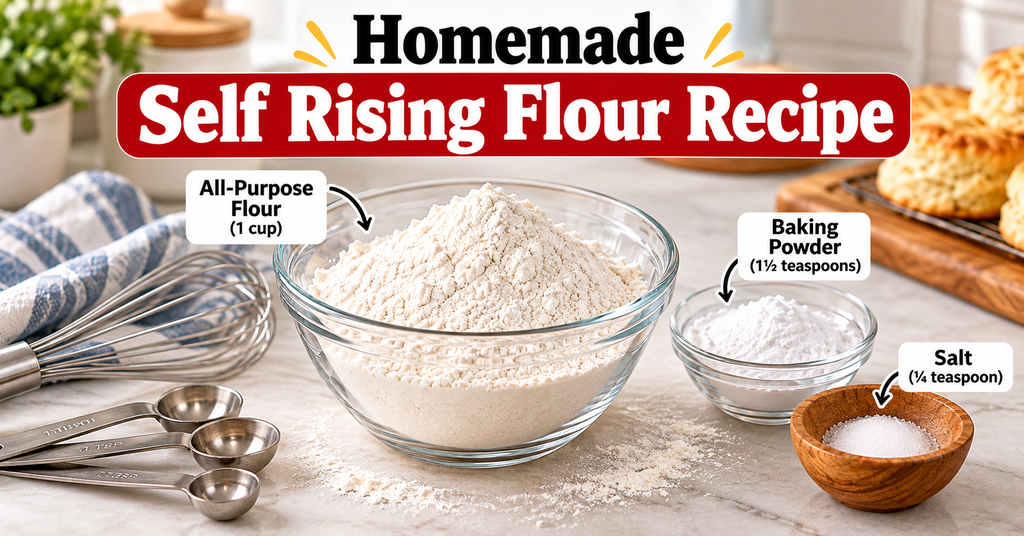
You don’t need special equipment or complicated measurements. A mixing bowl, measuring spoons, and a whisk are enough.
Ingredients
- 1 cup (120 g) all-purpose flour
- 1½ teaspoons baking powder
- ¼ teaspoon fine table salt
Instructions
- Measure the all-purpose flour into a medium mixing bowl. For greater accuracy, use a kitchen scale.
- Add the baking powder and fine table salt.
- Whisk thoroughly until all three ingredients are evenly distributed.
- Use immediately in a recipe calling for U.S.-style self-rising flour, or transfer to an airtight container.
- Label any stored mixture with the preparation date.
Thorough mixing matters. Unevenly distributed baking powder can cause irregular rising, an unpleasant metallic taste, or patches of dense texture. Sifting is optional; whisking thoroughly is generally sufficient.
The mixture makes approximately one cup of self-rising flour substitute.
Self Rising Flour at a Glance
| Ingredient | Amount | Purpose |
|---|---|---|
| All-purpose flour | 1 cup (120 g) | Provides structure |
| Baking powder | 1½ teaspoons | Helps baked goods rise |
| Fine table salt | ¼ teaspoon | Adds flavor |
| Yield | Approximately 1 cup | Homemade substitute |
| Preparation | 2–5 minutes | No cooking required |
Use this mixture when a recipe already specifies self-rising flour. Do not add baking soda to the basic formula.
Self Rising Flour Conversion Chart
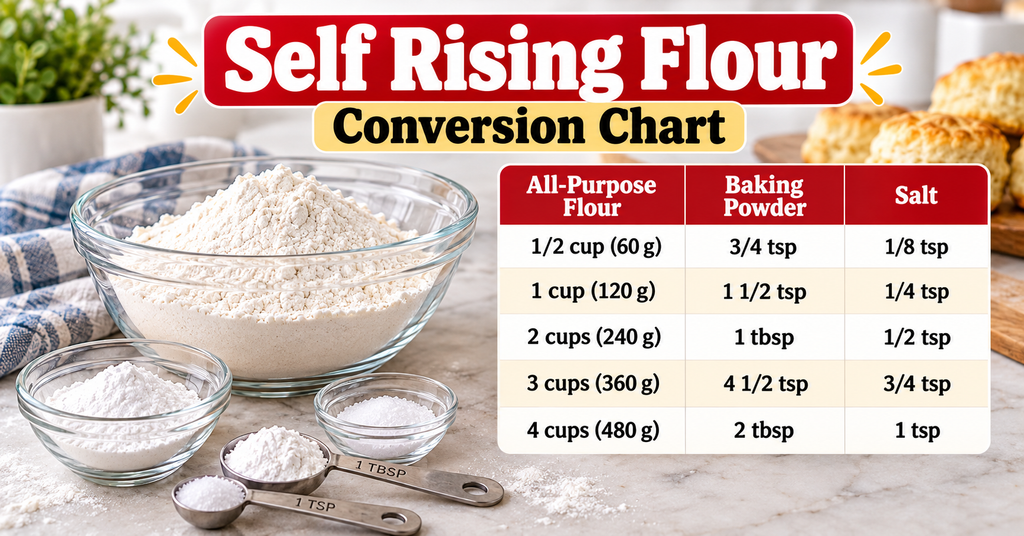
The easiest way to scale homemade self rising flour is to maintain the same baking powder and salt ratio for every cup of flour.
| Flour | Baking Powder | Fine Table Salt |
|---|---|---|
| ½ cup (60 g) | ¾ tsp | ⅛ tsp |
| 1 cup (120 g) | 1½ tsp | ¼ tsp |
| 2 cups (240 g) | 3 tsp (1 tbsp) | ½ tsp |
| 3 cups (360 g) | 4½ tsp | ¾ tsp |
| 4 cups (480 g) | 6 tsp (2 tbsp) | 1 tsp |
For example, if your biscuit recipe calls for two cups of self-rising flour, combine 240 g all-purpose flour with one tablespoon baking powder and half a teaspoon of fine salt.
The 120 g flour measurement follows King Arthur’s standard for its all-purpose flour. Other brands may use different cup weights, so weighing the flour is especially helpful when scaling recipes.
What Is Self Rising Flour?
Self-rising flour is wheat flour that already contains chemical leavening and salt. Instead of measuring these ingredients separately for every recipe, bakers can use a prepared mixture.
Each ingredient performs a specific function.
Flour supplies starch and proteins that help create the structure of baked goods.
Baking powder releases carbon dioxide when activated by moisture and heat. This gas helps doughs and batters expand during baking.
Salt enhances flavor and balances the other ingredients.
Traditional Southern-style self-rising flour is often milled from soft wheat. Such flour can have less protein than standard all-purpose flour, making it especially useful for tender biscuits and certain cakes. However, protein levels and formulations vary among manufacturers.
What Is the Correct Self Rising Flour Ratio?
The widely used U.S. homemade self rising flour ratio is:
For every 1 cup (120 g) all-purpose flour, add 1½ teaspoons baking powder and ¼ teaspoon fine table salt.
This ratio is specifically intended to create a substitute for self-rising flour. It should not be confused with the amount of baking powder needed in every cake, cookie, or muffin recipe.
Different recipes have their own leavening requirements. Likewise, commercial self-rising flour formulations are not necessarily identical.
When following the homemade formula, use fresh baking powder and distribute it evenly throughout the flour.
Why Flour Protein Matters
Flour protein influences the texture of baked goods. When wheat flour is mixed with liquid, two major proteins can form gluten, which gives dough structure and elasticity.
Higher-protein flour generally has greater gluten-forming potential. Lower-protein flour is often preferred when a soft, delicate texture is the goal.
For example, King Arthur reports these protein levels for its own products:
- All-purpose flour: approximately 11.7% protein.
- Self-rising flour: approximately 8.5% protein.
- Bread flour: approximately 12.7% protein.
These are brand-specific examples, not universal standards for all flour manufacturers.
If you make self-rising flour using higher-protein all-purpose flour, your biscuits may be slightly firmer than biscuits made with soft-wheat self-rising flour. The dough may also require a little additional liquid.
Adjust moisture according to the consistency described in your recipe rather than adding an arbitrary amount.
Homemade vs Store-Bought Self Rising Flour
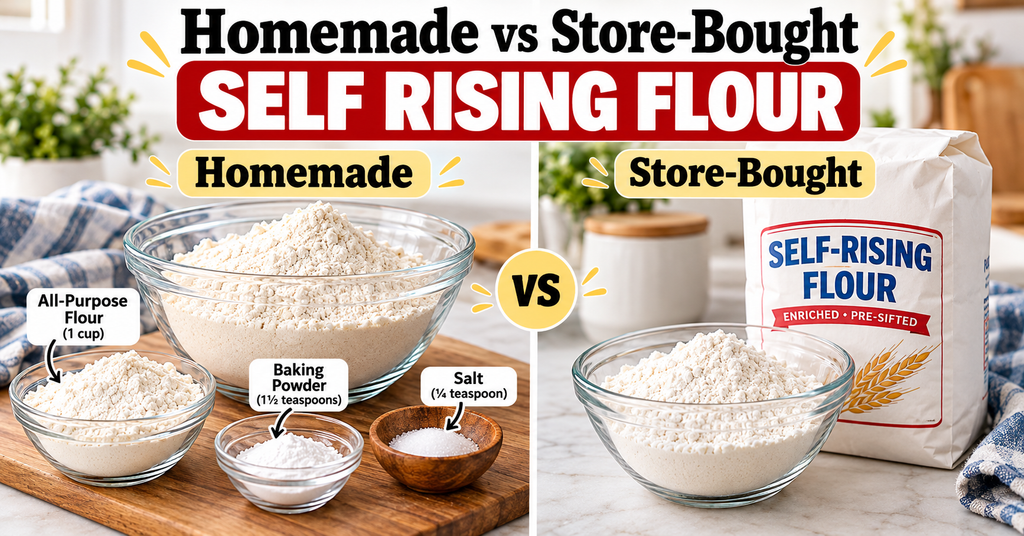
Homemade flour can replace commercial self-rising flour in many recipes, but the two are not always structurally identical.
| Feature | Homemade With All-Purpose Flour | Traditional Soft-Wheat Commercial Flour |
|---|---|---|
| Flour base | Standard all-purpose wheat flour | Often soft wheat |
| Protein | Depends on AP brand | Often lower; varies by brand |
| Leavening | Added baking powder | Preblended leavening |
| Salt | Added separately | Usually included |
| Texture | May be slightly firmer | Often more tender |
| Liquid absorption | May require more liquid | Depends on formulation |
| Convenience | Mix when needed | Ready from the bag |
| Best use | Everyday substitutions | Recipes designed for its texture |
Homemade self-rising flour is an excellent emergency alternative. Store-bought flour remains useful for bakers who frequently prepare Southern biscuits, tender quick breads, or recipes developed around a particular flour brand.
How to Make Softer Southern-Style Self Rising Flour
If tenderness is especially important, consider using lower-protein pastry flour instead of regular all-purpose flour.
King Arthur recommends pastry flour or its pastry flour blend as options when trying to approximate traditional Southern-style self-rising flour. Its pastry flour contains around 8% protein.
For a pastry-flour version, combine one cup-equivalent of an appropriate pastry flour with 1½ teaspoons baking powder and ¼ teaspoon fine table salt. Follow the flour manufacturer’s guidance for cup weight rather than assuming every flour weighs 120 g per cup.
This approach may produce softer biscuits or cakes, although it will not exactly reproduce every commercial self-rising flour.
Bread flour is generally a poor first choice for delicate baking because its higher protein content encourages stronger gluten development.
Cake flour can also be lower in protein, but different milling methods, cup weights, and absorption properties make direct substitution less predictable. For reliable results, follow a recipe or manufacturer conversion intended for that flour.
How to Use Homemade Self Rising Flour in Recipes

When a recipe specifically requests self-rising flour, replace that ingredient with an equivalent amount of your homemade mixture.
For example, a recipe requiring two cups of self-rising flour can use:
- 240 g all-purpose flour
- 1 tablespoon baking powder
- ½ teaspoon fine table salt
Mix these ingredients before incorporating them into the recipe.
Do not automatically add another complete portion of baking powder and salt. However, retain any additional ingredients that the original recipe explicitly requires.
Homemade self-rising flour is particularly useful for biscuits, pancakes, waffles, muffins, scones, cobblers, and certain quick breads.
Can You Replace All-Purpose Flour With Self Rising Flour?
Sometimes, but not in every recipe.
Self-rising flour already contains leavening and salt, while regular all-purpose flour does not. Replacing one with the other changes the ingredient balance.
King Arthur’s March 2026 guidance suggests that commercial self-rising flour can work well in recipes containing approximately ½ to 1 teaspoon baking powder per cup of flour.
When making that substitution, the original baking powder and salt generally need adjusting or omitting. Recipes requiring additional leavening may need more baking powder.
For recipes already developed around self-rising flour, using the ingredient as directed is simpler and more reliable.
Avoid casual substitutions in yeast breads, sourdough, conventional pizza dough, pasta, and choux pastry. These foods depend on different flour properties or leavening methods.
What If Your Recipe Calls for Baking Soda?
Baking powder and baking soda are different ingredients.
Baking powder contains both alkaline and acidic components. Most supermarket baking powders are double-acting, reacting when mixed with moisture and again during baking.
Baking soda is sodium bicarbonate. It generally needs an acidic ingredient in the recipe for its intended chemical reaction.
Common acidic ingredients include buttermilk, yogurt, molasses, citrus juice, and natural cocoa powder.
If your recipe includes baking soda, do not automatically remove it just because you are using self-rising flour.
Baking soda can contribute to rising, browning, flavor, and acidity balance. Retain it when the recipe requires it.
Standard homemade self-rising flour does not require separately added baking soda. Although baking powder itself contains sodium bicarbonate, that does not make the two ingredients interchangeable.
U.S. Self Rising Flour vs UK Self Raising Flour
The terms self-rising and self-raising sound nearly identical, but their formulations can differ.
| Feature | U.S. Self-Rising Flour | UK/Australian Self-Raising Flour |
|---|---|---|
| Common spelling | Self-rising | Self-raising |
| Flour | Often soft wheat in Southern products | Depends on manufacturer |
| Raising agent | Included | Included |
| Salt | Generally included | Often not included |
| Common recipes | Biscuits, pancakes, quick breads | Cakes, sponges, scones |
British baking instructions may use different proportions. For example, BBC Good Food provides guidance using two teaspoons baking powder per 150 g plain flour for homemade self-raising flour.
These ratios should not be combined indiscriminately.
If you are following a British or Australian recipe, check whether it expects salt to be added separately. The U.S. salt-containing mixture may otherwise affect the finished flavor.
Different flour weights, manufacturer formulations, protein levels, and intended recipes also help explain why homemade self-raising flour ratios vary online.
Can You Make Gluten-Free or Whole Wheat Self Rising Flour?
Yes, with some important adjustments.
For gluten-free baking, choose a formulated measure-for-measure flour blend intended to replace all-purpose wheat flour. King Arthur recommends its Gluten-Free Measure for Measure Flour for the same homemade self-rising method.
Add the baking powder and salt according to the blend’s supported equivalent quantity.
Individual alternatives such as almond flour, coconut flour, and plain rice flour should not be treated as automatic one-for-one replacements. They absorb liquid and build structure differently.
Whole wheat flour can also be combined with baking powder and salt. However, its bran and higher water absorption can change the texture, often producing heavier baked goods. Additional liquid or recipe adjustments may be necessary.
How to Test Baking Powder for Freshness
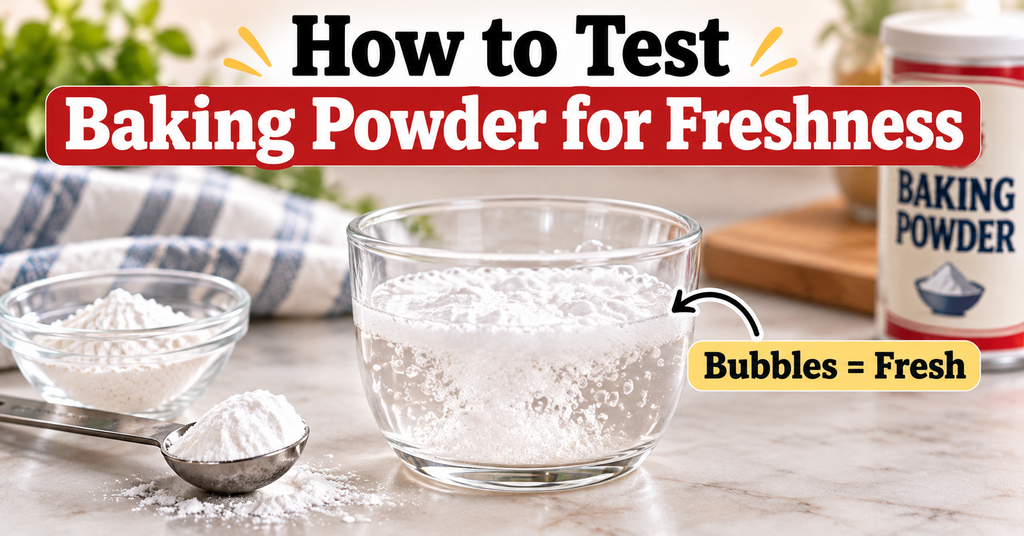
Fresh baking powder is essential for a dependable rise.
Before preparing your homemade flour, use this simple test:
- Put two tablespoons warm water into a small bowl.
- Add ½ teaspoon baking powder.
- Watch for noticeable bubbling and foaming.
- Replace the baking powder if the reaction is very weak.
Baking powder already contains an acidic component, so vinegar is unnecessary for this test.
Always check the manufacturer’s best-by date and keep baking powder protected from moisture. An expiration date is a useful quality indicator, but storage conditions also influence its effectiveness.
How to Store Homemade Self Rising Flour
Keep homemade self-rising flour in an airtight container in a cool, dry cupboard away from heat, steam, and direct moisture.
Label the container with the preparation date and avoid mixing fresh flour into an old batch without checking the older mixture.
Baking powder gradually loses effectiveness, especially after exposure to moisture. Therefore, the practical storage life of homemade self-rising flour depends partly on the condition of its leavening.
For best baking results, prepare only the amount you need or a modest quantity you expect to use reasonably soon.
Making it fresh also lets you check the baking powder, control the salt, and keep the remaining all-purpose flour available for other recipes.
Common Self Rising Flour Mistakes
Using baking soda instead of baking powder: Use baking powder in the homemade formula. Baking soda alone does not provide the same leavening system.
Measuring flour inaccurately: Avoid packing flour into a measuring cup. Weigh it whenever possible.
Using the wrong salt: Use fine table salt. Kosher salt crystals differ by brand, so equal teaspoon measurements may contain different amounts of salt.
Adding too much leavening: Do not increase the baking powder randomly. Too much can produce bitter flavors and uneven texture.
Assuming all commercial flours are identical: Different wheat varieties, protein levels, and leavening formulations can affect the final product.
Not mixing thoroughly: Whisk the ingredients well so baking powder and salt are distributed evenly.
Troubleshooting Homemade Self Rising Flour
| Problem | Likely Cause | Practical Fix |
|---|---|---|
| Dense biscuits | Weak baking powder, overmixing, high-protein flour | Test powder, handle dough gently |
| Flat baked goods | Inactive powder, incorrect ratio, oven issues | Check leavener and baking temperature |
| Bitter taste | Excess or uneven baking powder | Measure accurately and whisk |
| Too salty | Wrong salt quantity or duplicate salt | Use fine table salt and review recipe |
| Dry dough | Excess flour or greater liquid absorption | Adjust liquid gradually |
| Uneven rise | Poor ingredient distribution | Thoroughly whisk dry ingredients |
If biscuits made with all-purpose-based self-rising flour seem unusually dry, add liquid carefully until the dough reaches the expected consistency.
Remember that dry self-rising flour does not rise by itself in a container. The baking powder produces gas after it is incorporated into a hydrated recipe.
FAQs
1. How do you make self rising flour?
Combine one cup (120 g) all-purpose flour with 1½ teaspoons baking powder and ¼ teaspoon fine table salt. Whisk thoroughly until evenly distributed. Use this mixture in place of approximately one cup of U.S.-style self-rising flour in a recipe that calls for it.
2. How much baking powder do I add to one cup of flour?
For the standard U.S. homemade self-rising flour substitute, add 1½ teaspoons baking powder to one cup (120 g) all-purpose flour. Also include ¼ teaspoon fine table salt. This is a substitute formula, not a universal baking powder quantity for every recipe.
3. How do I make two cups of self rising flour?
Mix two cups (240 g) all-purpose flour, one tablespoon baking powder, and half a teaspoon fine table salt. Whisk until evenly combined. Use the entire mixture in a recipe requiring approximately two cups of self-rising flour.
4. Is self rising flour the same as all-purpose flour?
No. All-purpose flour does not contain built-in baking powder or salt, while U.S.-style self-rising flour generally contains both. Commercial self-rising flour may also use softer wheat with less protein, producing a different texture from standard all-purpose flour.
5. Can I use bread flour to make self rising flour?
You can add baking powder and salt to bread flour, but the result will not closely resemble traditional soft-wheat self-rising flour. Higher protein encourages stronger gluten formation, which may be undesirable for tender biscuits or cakes.
6. Does self rising flour contain baking soda?
Self-rising flour normally contains baking powder rather than separately added baking soda. Baking powder includes sodium bicarbonate within its formulated leavening system. A recipe may still require additional baking soda when acidic ingredients or particular baking properties make it necessary.
7. Is self raising flour the same as self rising flour?
They serve similar purposes, but formulations vary. U.S. self-rising flour generally includes salt, while British and Australian self-raising flour often does not. Homemade baking powder ratios may also differ, so follow the conventions of the original recipe.
8. Can I make gluten-free self rising flour?
Yes. Start with a measure-for-measure gluten-free flour specifically designed to replace all-purpose flour. Add baking powder and salt using the manufacturer’s supported quantities. Avoid substituting individual coconut, almond, or rice flours without a recipe formulated for them.
9. How long does homemade self rising flour last?
There is no single guaranteed shelf life because the baking powder’s freshness and storage conditions affect performance. Keep the mixture airtight in a cool, dry location and label it with the date. Preparing fresh batches is generally the most dependable approach.
10. How can I tell whether my baking powder still works?
Stir ½ teaspoon baking powder into two tablespoons warm water. It should bubble and foam noticeably. If the reaction is weak or absent, replace the baking powder before using it in a homemade self-rising flour mixture.
Conclusion
Knowing how to make self rising flour gives you an easy substitute when the store-bought version is unavailable. Simply combine one cup (120 g) all-purpose flour, 1½ teaspoons baking powder, and ¼ teaspoon fine table salt.
For dependable results, measure accurately, use fresh baking powder, and whisk thoroughly. Keep in mind that commercial soft-wheat self-rising flour can produce a slightly different texture, especially in delicate biscuits and cakes. For most everyday substitutions, however, this three-ingredient mixture is convenient, inexpensive, and easy to prepare.
Read more: How to Make a Sourdough Starter: Easy Step-by-Step Guide

2 Comments
Pingback: How Much Do You Have to Make to File Taxes in 2026?
Pingback: How to Make Baked Macaroni and Cheese: Easy Recipe Copy Title