
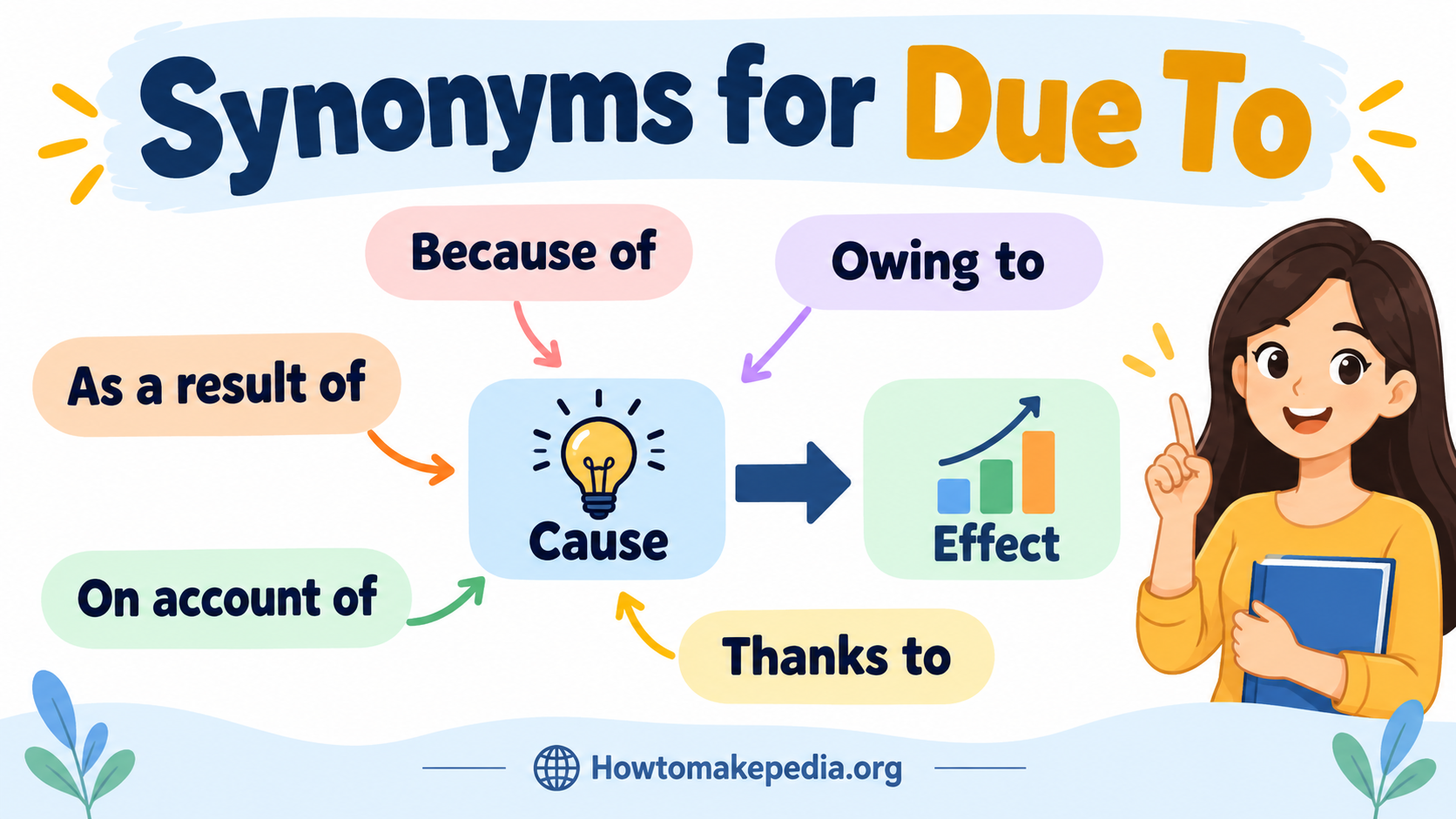

The phrase “due to” explains why something happens. Common synonyms for due to include because of, owing to, as a result of, on account of, and thanks to. Although these expressions describe reasons or causes, they aren’t always interchangeable.
Some work naturally in everyday conversations, while others fit formal reports or academic writing. Choosing the right alternative depends on the sentence structure, intended meaning, and tone.
What Does Due To Mean?
“Due to” means because of or as a result of. It connects an event, condition, or outcome to its cause.
Examples:
- The concert was postponed due to a technical problem.
- Her improvement was due to consistent practice.
The phrase can describe positive, negative, or neutral situations.
However, “due to” has another use. In “The train is due to arrive at noon,” it means the train is expected or scheduled to arrive. Here, “because of” would not make sense.
Best Synonyms for Due To
The following expressions can replace “due to” in suitable contexts. Some require changes to the original sentence.
| Alternative | Meaning or nuance | Usage |
|---|---|---|
| Because of | Gives a cause or reason | Everyday |
| Owing to | Explains a cause | Slightly formal |
| As a result of | Emphasizes an outcome | Neutral or formal |
| On account of | Gives a reason | Somewhat formal |
| Thanks to | Gives credit or expresses irony | Positive or ironic |
| By reason of | States a formal basis or cause | Legal or formal |
| Attributable to | Assigns responsibility or cause | Analytical |
| Caused by | Identifies a direct cause | Requires suitable structure |
| Resulting from | Connects an outcome to its cause | Formal |
| Arising from | Indicates the source of a situation | Formal |
| Stemming from | Identifies an underlying cause | Context-dependent |
Quick tip: “Because of” is usually the simplest choice when you want to replace “due to” without changing the meaning.
Common Alternatives to Due To With Examples
1. Because Of
“Because of” is one of the most natural alternatives. It introduces a reason without making the sentence sound especially formal.
Example: The outdoor market closed early because of strong winds.
It works well in emails, school assignments, reports, and conversations.
2. Owing To
“Owing to” has nearly the same causal meaning but often sounds more formal.
Example: The conference was rescheduled owing to a venue conflict.
It is useful in professional notices and written announcements.
3. As a Result Of
This expression emphasizes the connection between an earlier event and its consequence.
Example: Several businesses lost electricity as a result of the equipment failure.
Choose it when the outcome deserves particular attention.
4. On Account Of
“On account of” introduces a reason, although it can sound less conversational than “because of.”
Example: The employee was granted additional leave on account of a family emergency.
It can work in formal explanations and notices.
5. Thanks To
“Thanks to” generally gives someone or something credit for a positive result.
Example: Thanks to the volunteers, the community garden opened ahead of schedule.
It can also express frustration or sarcasm: “Thanks to the broken printer, we missed our deadline.”
6. Attributable To
“Attributable to” identifies the factor responsible for a result. It is particularly useful in analytical writing.
Example: The improvement in customer satisfaction was attributable to faster response times.
This phrase often appears after linking verbs such as “is” or “was.”
7. Caused By
“Caused by” identifies what produced a particular result.
Example: The unusual noise was caused by a loose mechanical part.
It works in many passive constructions. An active sentence may be clearer: “A loose mechanical part caused the unusual noise.”
8. Stemming From
“Stemming from” emphasizes where a problem, situation, or outcome originated.
Example: The disagreement was stemming from a misunderstanding about responsibilities.
More naturally, write: “The disagreement stemmed from a misunderstanding about responsibilities.”
This expression is useful when explaining underlying causes.
Formal Alternatives to Due To
Professional and academic writing sometimes benefits from more specific causal expressions.
Owing to works well in announcements: “The inspection was delayed owing to staffing shortages.”
As a result of emphasizes consequences: “Production declined as a result of reduced demand.”
Attributable to suits analytical findings: “The variation was attributable to differences in temperature.”
Arising from identifies the source of a situation: “The report examines risks arising from outdated equipment.”
By reason of appears in formal and legal contexts but can sound unnecessarily stiff in ordinary writing.
Remember that longer phrases are not automatically better. “Because of” is entirely appropriate in many professional documents.
Due To vs. Because Of
“Due to” and “because of” often express the same cause.
Due to: The cancellation was due to insufficient registration.
Because of: The event was canceled because of insufficient registration.
Traditional grammar guidance often preferred “due to” after linking verbs, where it describes a noun or situation. “Because of” was preferred when modifying an action.
Modern English accepts broader uses of “due to,” including uses at the beginning of sentences.
For conservative formal editing, “because of” is a safe, straightforward alternative.
Because vs. Because Of vs. Due To
These expressions have similar meanings but different grammatical patterns.
Because + clause
Use “because” before a subject and verb.
Correct: The store closed because the heating system failed.
Incorrect: The store closed because a heating failure.
Because of + noun phrase
Use “because of” before a noun, noun phrase, or suitable equivalent.
Correct: The store closed because of a heating failure.
Incorrect: The store closed because of the heating system failed.
Due to + noun phrase
“Due to” commonly introduces a cause followed by a noun phrase.
Correct: The closure was due to a heating failure.
When replacing “due to” with “because,” you usually need to rewrite the reason as a complete clause.
Due To vs. Owing To
Both phrases explain causes, but “owing to” often sounds slightly more formal.
Compare:
- The delivery was delayed due to road repairs.
- The delivery was delayed owing to road repairs.
Both sentences are natural.
In business notices, “owing to” can give an announcement a more formal tone. In everyday American English, “because of” is often more conversational.
Neither “due to” nor “owing to” is automatically the better choice. Meaning, readability, and editorial style matter more.
Can You Start a Sentence With Due To?
Yes. Starting a sentence with “due to” is common in modern English.
Example: Due to unexpected maintenance, the library will open late.
Some traditional style guides discourage this construction because they treat “due to” primarily as an adjectival expression.
For conservative formal writing, you can use:
Alternative: Because of unexpected maintenance, the library will open late.
Both forms are understandable, but the second avoids the traditional style objection.
How to Replace Due To in Sentences
These examples show how to change expressions without losing the original meaning.
| Original sentence | Improved alternative |
|---|---|
| The workshop was canceled due to a heating failure. | The workshop was canceled because of a heating failure. |
| The shipment arrived late due to a supplier issue. | The shipment arrived late owing to a supplier issue. |
| Downtown roads were closed due to an electrical fire. | Downtown roads were closed as a result of an electrical fire. |
| The expense increase was due to higher insurance costs. | The expense increase was attributable to higher insurance costs. |
| The website went offline due to a database error. | A database error caused the website to go offline. |
| The students improved due to regular feedback. | The students improved thanks to regular feedback. |
| Several complaints occurred due to unclear instructions. | Several complaints arose from unclear instructions. |
| The lab repeated the test due to unexpected readings. | Because the readings were unexpected, the lab repeated the test. |
Notice that some replacements change the grammatical structure. “Caused by,” for example, can be replaced with the active verb “caused” when it makes the sentence clearer.
Common Mistakes When Using Due To Synonyms
1. Confusing “owing” with “owning.” The correct causal expression is “owing to,” not “owning to.”
2. Mixing up because and because of. Write “because the computer crashed” or “because of the computer crash,” not “because of the computer crashed.”
3. Treating every expression as interchangeable. “In light of” often explains information considered when making a decision rather than a direct cause.
4. Using “thanks to” without considering tone. It may express appreciation, criticism, or irony. Choose “because of” when you need a neutral explanation.
5. Replacing unrelated meanings. In “The manager is due to speak tomorrow,” the phrase describes an expected event. Likewise, “based on” usually describes a foundation or supporting information, not necessarily a cause.
Frequently Asked Questions
What Is the Best Synonym for Due To?
“Because of” is usually the best everyday alternative. It communicates a cause clearly and works in many sentence structures. “Owing to” is also useful when a slightly more formal tone is appropriate.
Is Owing To the Same as Due To?
Both phrases can introduce a cause or reason. Their meanings overlap considerably, although “owing to” may sound more formal. The best choice depends on the sentence and the style of writing.
Can I Use Because Instead of Due To?
Yes, but the sentence usually needs restructuring. “Because” introduces a clause containing a subject and verb, while causal “due to” normally precedes a noun phrase.
What Is a Formal Alternative to Due To?
“Owing to,” “as a result of,” and “attributable to” are useful formal options. The appropriate choice depends on whether you are announcing a reason, describing a consequence, or assigning a cause.
Is It Correct to Start a Sentence With Due To?
Yes, sentence-initial “due to” is established in contemporary English. However, some conservative editorial styles prefer “because of” or “owing to” when introducing the reason for an action.
Conclusion
The most useful synonyms for due to are “because of,” “owing to,” “as a result of,” and “on account of.” “Thanks to” works when credit or irony is intended, while other alternatives may require rewriting.
Before making a replacement, check the meaning, grammatical structure, and tone. The clearest expression is usually the best choice.
