
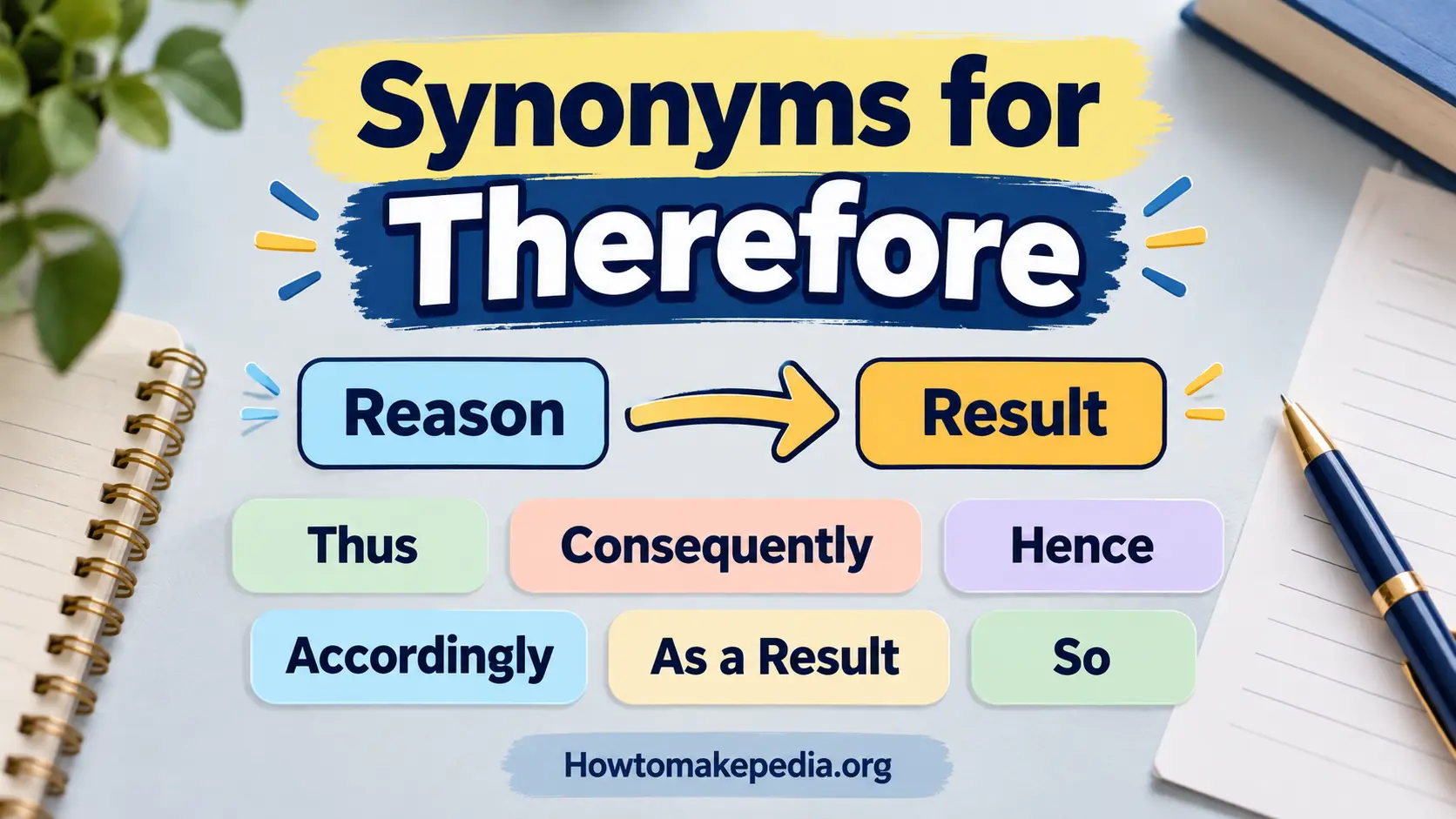

The best synonyms for therefore include thus, consequently, hence, accordingly, as a result, for this reason, and so. These words help connect a reason, result, or logical conclusion to an earlier statement.
However, they are not always interchangeable. Some sound more natural in academic writing, while others work better in everyday conversations. Choosing the right alternative depends on what you want to express and how your sentence is structured.
What Does Therefore Mean?
Therefore is an adverb that introduces a conclusion, consequence, or result based on information already given. It often means “for that reason” or “as a result.”
Consider these examples:
Practical consequence: “The restaurant had no available tables; therefore, we made a reservation elsewhere.”
Logical inference: “All registered members have an identification number. Maria is a registered member; therefore, she has an identification number.”
The first sentence explains a decision caused by circumstances. The second draws a conclusion from established facts.
Therefore is particularly common in academic papers, business reports, scientific discussions, and formal explanations.
Best Synonyms for Therefore
The following table compares 12 useful alternatives. Some are close synonyms, while others require changes to sentence structure.
| Alternative | Tone | Best Use |
|---|---|---|
| Thus | Formal | Logical conclusions |
| Consequently | Formal | Results and consequences |
| Hence | Formal | Reasoned inferences |
| Accordingly | Professional | Decisions and responses |
| As a result | Neutral | Cause and effect |
| For this reason | Neutral | Explaining decisions |
| For that reason | Neutral | Referring to an earlier reason |
| As a consequence | Formal | Outcomes of events |
| Because of this | Neutral | Explaining causes |
| That is why | Conversational | Everyday explanations |
| It follows that | Academic | Logical deductions |
| So | Informal/Neutral | Everyday results |
These alternatives share related meanings, but their grammar and emphasis can differ.
Common Alternatives to Therefore With Examples
1. Thus
Thus introduces a conclusion or consequence and is particularly useful in formal writing.
Example: “The measurements were inconsistent; thus, the experiment was repeated.”
Thus can also mean “in this way,” as in “She reorganized the files, thus saving time.”
2. Consequently
Consequently emphasizes something that happens because of a previous event or situation.
Example: “The shipment arrived late; consequently, production started behind schedule.”
It is especially suitable for reports and professional explanations.
3. Hence
Hence expresses a logical conclusion in concise, often formal language.
Example: “The password has expired; hence, a reset is necessary.”
Hence also has other meanings. For example, “three months hence” means three months from now.
4. Accordingly
Accordingly often introduces an action taken in response to information, instructions, or circumstances.
Example: “The client requested a shorter proposal; accordingly, the team revised its draft.”
It works well in business correspondence.
5. As a Result
As a result highlights the outcome of an earlier situation.
Example: “Heavy snowfall blocked several highways. As a result, deliveries were postponed.”
This phrase is clear and suitable for both formal and everyday writing.
6. For This Reason
For this reason directly explains why a decision or conclusion follows.
Example: “The apartment has limited storage space. For this reason, we chose smaller furniture.”
“For that reason” works similarly.
7. Because of This
Because of this points back to a situation that explains what follows.
Example: “The instructions were unclear. Because of this, several employees made the same mistake.”
It is a prepositional phrase, so replacing therefore may require restructuring the sentence.
8. So
So is one of the most natural alternatives in conversation.
Example: “We finished our homework early, so we went outside.”
Unlike therefore, so can act as a coordinating conjunction connecting two independent clauses.
Formal Synonyms for Therefore
In academic essays, research papers, and professional reports, thus, consequently, hence, accordingly, and it follows that are useful choices.
For example:
“The available evidence supports the hypothesis. It follows that further testing is justified.”
The phrase “it follows that” is particularly helpful when introducing a conclusion supported by reasoning.
“Ergo” can also express an inference, but it often sounds deliberately scholarly or playful. It is rarely the best choice for ordinary business writing.
Formal writing does not always require complicated vocabulary. “As a result” may communicate an idea more clearly than a less familiar expression.
Informal Ways to Say Therefore
In casual conversations, therefore can sound unnecessarily formal.
Compare:
Formal: “I had an early appointment; therefore, I went to bed before ten.”
Conversational: “I had an early appointment, so I went to bed before ten.”
Other natural expressions include “that is why,” “because of this,” and “for that reason.”
For instance, “My phone battery died. That is why I couldn’t answer your call” sounds natural in everyday American English.
Therefore vs. Thus vs. Consequently
These three expressions frequently overlap, but each has a slightly different emphasis.
Therefore introduces a conclusion or result based on earlier information.
“The application was incomplete; therefore, it could not be approved.”
Thus also expresses a conclusion and can suggest that something follows logically.
“The two measurements agree; thus, the calculation appears consistent.”
Consequently often emphasizes the outcome of an earlier event.
“The building lost electricity; consequently, the elevators stopped operating.”
These distinctions are tendencies, not strict rules. Context determines which expression fits best.
Therefore vs. Hence vs. Accordingly
Therefore and hence both introduce conclusions, although hence generally sounds more formal.
“Several required documents are missing; hence, the submission is incomplete.”
Accordingly more often describes a suitable response to circumstances.
“The inspection identified damaged equipment; accordingly, maintenance was scheduled.”
The important difference is emphasis: an inference versus an action taken in response.
How to Use Therefore Correctly
Can You Start a Sentence With Therefore?
Yes. Starting a sentence with therefore is grammatically correct.
Example: “The results were inconclusive. Therefore, additional research is needed.”
A comma usually follows therefore when it introduces a sentence.
Using Therefore With a Semicolon
A semicolon can connect two related independent clauses.
Correct: “The office was closed; therefore, the meeting was rescheduled.”
Incorrect: “The office was closed, therefore, the meeting was rescheduled.”
The incorrect example contains a comma splice. Therefore is a conjunctive adverb, not a coordinating conjunction.
Therefore vs. So: Punctuation
Compare these constructions:
Therefore: “The roads were flooded; therefore, the buses stopped running.”
So: “The roads were flooded, so the buses stopped running.”
A comma before so is appropriate when it joins two independent clauses. Therefore normally requires a semicolon or a new sentence in this construction.
Therefore Within a Sentence
Therefore does not always need surrounding commas.
Example: “The report contains errors and therefore requires revision.”
Another correct construction is “We therefore recommend additional testing.”
Avoid redundant combinations such as “therefore, as a result.” Choose one transition.
Also, make sure the conclusion is justified. A locked door does not necessarily mean nobody is inside, regardless of which transition word you use.
How to Replace Therefore in Sentences
Here are six practical examples showing how to replace therefore without changing the intended meaning.
1. School assignment
Original: “The essay lacked supporting evidence; therefore, the student revised it.”
Rewrite: “The essay lacked supporting evidence, so the student revised it.”
So makes the sentence more conversational.
2. Academic research
Original: “The sample was too small; therefore, the findings were inconclusive.”
Rewrite: “The sample was too small; consequently, the findings were inconclusive.”
Consequently emphasizes the outcome.
3. Business decision
Original: “Customer demand increased; therefore, the company hired more staff.”
Rewrite: “Customer demand increased. Accordingly, the company hired more staff.”
Accordingly emphasizes the company’s response.
4. Weather disruption
Original: “Strong winds damaged the bridge; therefore, traffic was redirected.”
Rewrite: “Strong winds damaged the bridge. As a result, traffic was redirected.”
As a result clearly communicates the consequence.
5. Budget planning
Original: “Our expenses exceeded the budget; therefore, we postponed the purchase.”
Rewrite: “Our expenses exceeded the budget. For this reason, we postponed the purchase.”
For this reason emphasizes the decision’s justification.
6. Technical report
Original: “The device failed all three safety checks; therefore, it does not meet the testing requirements.”
Rewrite: “The device failed all three safety checks; thus, it does not meet the testing requirements.”
Thus preserves the formal conclusion.
Words That Are Not Exact Synonyms for Therefore
Not every transition word expresses a result or conclusion.
Furthermore adds information, while however introduces contrast. In conclusion signals that a discussion is ending.
Other expressions have particular limitations. “Thereby” generally means “by that means,” while “thereupon” may describe something happening immediately afterward. “Appropriately” describes suitability rather than inference.
Rare expressions such as “therefrom,” “thence,” and “resultantly” are usually unnecessary in modern American writing.
Choose a familiar expression that accurately communicates the relationship between your ideas.
Frequently Asked Questions
What Is the Best Synonym for Therefore?
Thus, consequently, and as a result are among the most useful alternatives. The best choice depends on whether you are expressing a logical inference, describing a consequence, or explaining a decision.
Is Thus the Same as Therefore?
Both words can introduce conclusions or consequences. However, thus can also mean “in this way,” so it cannot replace therefore in every sentence.
What Is a Formal Alternative to Therefore?
Consequently, hence, thus, and accordingly are suitable for formal writing. “It follows that” is especially useful when presenting a conclusion supported by evidence or reasoning.
Can I Use So Instead of Therefore?
Yes, particularly in informal writing. However, their grammatical functions differ. So can join independent clauses after a comma, while therefore generally requires a semicolon or separate sentence.
Can I Start a Sentence With Therefore?
Yes. Therefore can begin a sentence when the preceding information supports the conclusion. A comma usually follows it, as in “Therefore, the original proposal needs revision.”
Conclusion
The most useful synonyms for therefore depend on your intended meaning. Thus and hence suit formal reasoning, while consequently and as a result highlight outcomes. Accordingly often introduces a response, and so sounds natural in conversation.
Choose the alternative that preserves your meaning, matches your tone, and fits the sentence’s grammar.
