
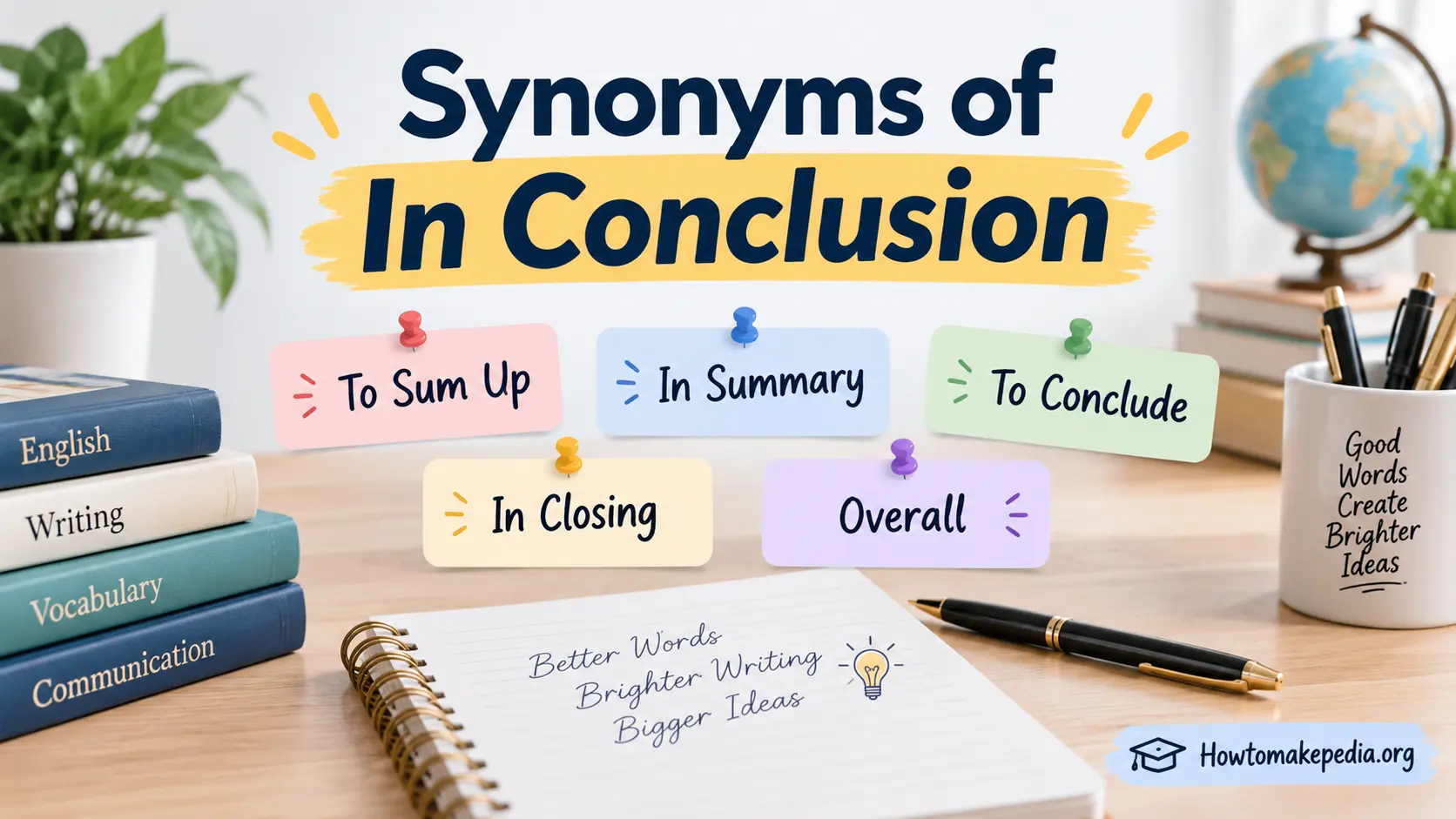

The best synonyms of in conclusion include to sum up, in summary, to conclude, in closing, overall, and in short. These expressions help writers finish essays, reports, speeches, and presentations without repeating the same phrase.
However, they don’t all mean exactly the same thing. Some summarize information, others introduce a final judgment, and a few work best in conversation. Choosing the right expression depends on your purpose, audience, and tone.
What Does In Conclusion Mean?
In conclusion is a transition phrase that introduces the final statement or closing section of a discussion.
It commonly appears in academic essays, school assignments, speeches, presentations, and business reports.
Examples:
- In conclusion, regular reading helps students develop stronger vocabulary skills.
- In conclusion, the proposed schedule offers a practical solution to the staffing problem.
Although grammatically correct, the phrase can sound predictable when every essay ends the same way.
A good conclusion does more than announce an ending. It connects the main ideas and explains why they matter.
Best Synonyms of In Conclusion
These alternatives have different functions. Some directly signal a conclusion, while others introduce a summary or overall assessment.
| Phrase | Meaning or Function | Best Context |
|---|---|---|
| To sum up | Summarizes main ideas | Essays, presentations |
| In summary | Reviews important points | Reports, academic writing |
| To conclude | Introduces closing remarks | Essays, speeches |
| In closing | Signals final remarks | Speeches, formal messages |
| In sum | Gives a concise summary | Academic writing |
| To summarize | Reviews key information | Research, presentations |
| In short | States the central point briefly | Essays, everyday writing |
| In brief | Provides a condensed explanation | Reports |
| Overall | Gives a general assessment | Reviews, analytical writing |
| All in all | Expresses a final judgment | Informal writing |
| Ultimately | Emphasizes a final judgment | Analytical essays |
| On the whole | Evaluates something generally | Reviews, discussions |
The first eight are particularly useful when summarizing or closing a discussion. The remaining expressions are contextual alternatives rather than exact replacements.
Formal Alternatives to In Conclusion
Formal writing benefits from clear expressions that accurately describe the purpose of the final paragraph.
1. In Summary
Use this phrase when briefly reviewing important findings.
Example: In summary, the survey results show consistent support for flexible working hours.
2. To Conclude
This expression directly introduces the closing statement of an essay, report, or speech.
Example: To conclude, the evidence supports continued investment in public transportation.
3. In Sum
A concise alternative frequently suited to analytical and academic writing.
Example: In sum, the three studies identify similar patterns in consumer behavior.
4. In the Final Analysis
Use this when presenting a considered judgment after examining several factors.
Example: In the final analysis, the policy’s benefits outweigh its administrative costs.
Other useful expressions include to summarize, in brief, and in essence. The last phrase emphasizes an idea’s essential meaning rather than necessarily announcing an ending.
Informal Ways to Say In Conclusion
Everyday conversations, friendly emails, and casual presentations allow more relaxed wording.
- All in all: Introduces a general opinion. “All in all, we had a productive weekend.”
- In a nutshell: Gives a very short explanation. “In a nutshell, the project needs more funding.”
- To wrap things up: Signals that a conversation or presentation is ending. “To wrap things up, let’s review our next steps.”
- Long story short: Shortens a longer account. “Long story short, we missed the train but arrived on time.”
- To recap: Reviews points already discussed. “To recap, everyone will submit their reports by Friday.”
These phrases sound natural in meetings and conversations. However, long story short and in a nutshell are generally too casual for formal research papers.
Best Conclusion Phrases for Essays
The ideal closing expression depends on the type of essay.
Argumentative essays: Use ultimately or in the final analysis when emphasizing a supported judgment.
Informative essays: Use in summary or to summarize when reviewing central information.
Analytical essays: Use in sum or begin directly with an interpretation of the evidence.
Short classroom assignments: To conclude and in short are usually straightforward choices.
Argumentative essay ending:
“Ultimately, expanding public transportation provides a practical way to improve access to jobs while reducing dependence on private vehicles.”
Analytical essay ending:
“The character’s final decision brings the story’s central conflict into focus, showing how loyalty can become a source of personal sacrifice.”
Both examples communicate a final idea without mechanically repeating the introduction.
Conclusion Phrases for Speeches and Presentations
Spoken presentations often benefit from clear closing signals.
In closing: “In closing, I want to thank everyone who contributed to this year’s program.”
To conclude: “To conclude, our research points to three practical improvements.”
As a final thought: “As a final thought, small changes in daily habits can produce meaningful results.”
Before I finish: “Before I finish, I’d like to recognize our volunteers.”
These expressions help listeners recognize that the speaker is approaching the end.
In Conclusion vs. In Summary vs. Overall
These three expressions serve related but distinct purposes.
In conclusion announces the closing part of a discussion.
Example: In conclusion, the committee recommends approving the proposal.
In summary introduces a shortened review of previously discussed information.
Example: In summary, the proposal addresses staffing, scheduling, and equipment needs.
Overall introduces a broad assessment of a situation.
Example: Overall, the new scheduling system performed better than expected.
Use in summary to recap, overall to evaluate, and in conclusion to signal a closing statement.
In Conclusion vs. Therefore
Therefore introduces a logical inference or consequence. It does not merely tell readers that a discussion is ending.
Compare these sentences:
Closing: “In conclusion, the training program met its primary objectives.”
Inference: “Employee accuracy improved after training; therefore, the company expanded the program.”
Thus, hence, consequently, and as a result also commonly express an inference or consequence rather than a simple closing.
Introductory transitions usually take a comma:
“Overall, the results were encouraging.”
When therefore connects two independent clauses, use a semicolon before it or start a new sentence.
Avoid the comma splice:
“The results improved, therefore, the program continued.”
How to End an Essay Without Saying In Conclusion
You don’t always need a transition phrase. A direct opening can make the final paragraph more confident and less repetitive.
A strong ending can emphasize the central argument, connect important findings, explain their significance, or recommend an action supported by the evidence.
Weak conclusion:
“In conclusion, school libraries are important, and this essay discussed several reasons why.”
Stronger conclusion:
“School libraries give students access to books, research materials, and quiet study spaces that support learning beyond the classroom.”
The revision communicates the takeaway instead of announcing that the essay is finished.
Avoid introducing major unsupported claims in the final paragraph.
8 Examples of Replacing In Conclusion
Here are eight natural rewrites for different writing situations.
| Context | Before | Better Alternative |
|---|---|---|
| School essay | In conclusion, homework requires balance. | To sum up, homework requires balance. |
| Research paper | In conclusion, the findings indicate improvement. | In summary, the findings indicate improvement. |
| Business report | In conclusion, sales increased across most regions. | Overall, sales increased across most regions. |
| Professional email | In conclusion, please review the attached proposal. | As a final request, please review the attached proposal. |
| Classroom presentation | In conclusion, recycling reduces waste. | To conclude, recycling reduces waste. |
| Persuasive speech | In conclusion, our community needs safer crossings. | In closing, our community needs safer crossings. |
| Informal conversation | In conclusion, the trip went well. | All in all, the trip went well. |
| Blog article | In conclusion, regular maintenance saves time. | In short, regular maintenance saves time. |
Notice that overall changes the emphasis toward evaluation, while in summary signals a recap. The best rewrite preserves the original meaning.
Common Mistakes When Using Conclusion Phrases
Writers sometimes confuse expressions that appear near the end of a discussion.
- Therefore, thus, hence, and consequently express logical relationships, not necessarily an ending.
- Finally and lastly often introduce the last item in a sequence rather than summarize an argument.
- At last usually suggests that something happened after a wait.
- In retrospect means reconsidering past events with later knowledge.
- Summarily is not a normal conclusion opener, while in fine is rare or archaic in modern American English.
Also avoid stacking expressions such as “Finally, in conclusion, to summarize.”
Choose one suitable transition—or none—and finish with a specific, meaningful statement.
Frequently Asked Questions
What is the best synonym for in conclusion?
To conclude is one of the closest alternatives because it directly signals a closing statement. To sum up and in summary are better when your main purpose is to recap information.
What can I say instead of in conclusion in an essay?
Try in sum, to conclude, in summary, or ultimately, depending on your meaning. You can also begin the final paragraph directly with your main takeaway.
What is a formal way to say in conclusion?
In sum, to conclude, and in the final analysis can work in formal writing. Choose according to whether you are summarizing information or expressing a reasoned judgment.
Is overall the same as in conclusion?
Not exactly. Overall presents a general assessment, while in conclusion signals the closing section. They sometimes work in the same position but emphasize different things.
Can I end an essay without saying in conclusion?
Yes. Begin with a sentence that connects your main arguments or explains their significance. A clear final insight is often more effective than a predictable transition.
Conclusion
The most useful synonyms of in conclusion include to sum up, in summary, to conclude, in closing, and in sum. Choose a phrase according to whether you want to summarize information, offer an overall judgment, or finish a presentation.
When your final point already follows naturally from the discussion, skip the transition and state it directly.
