
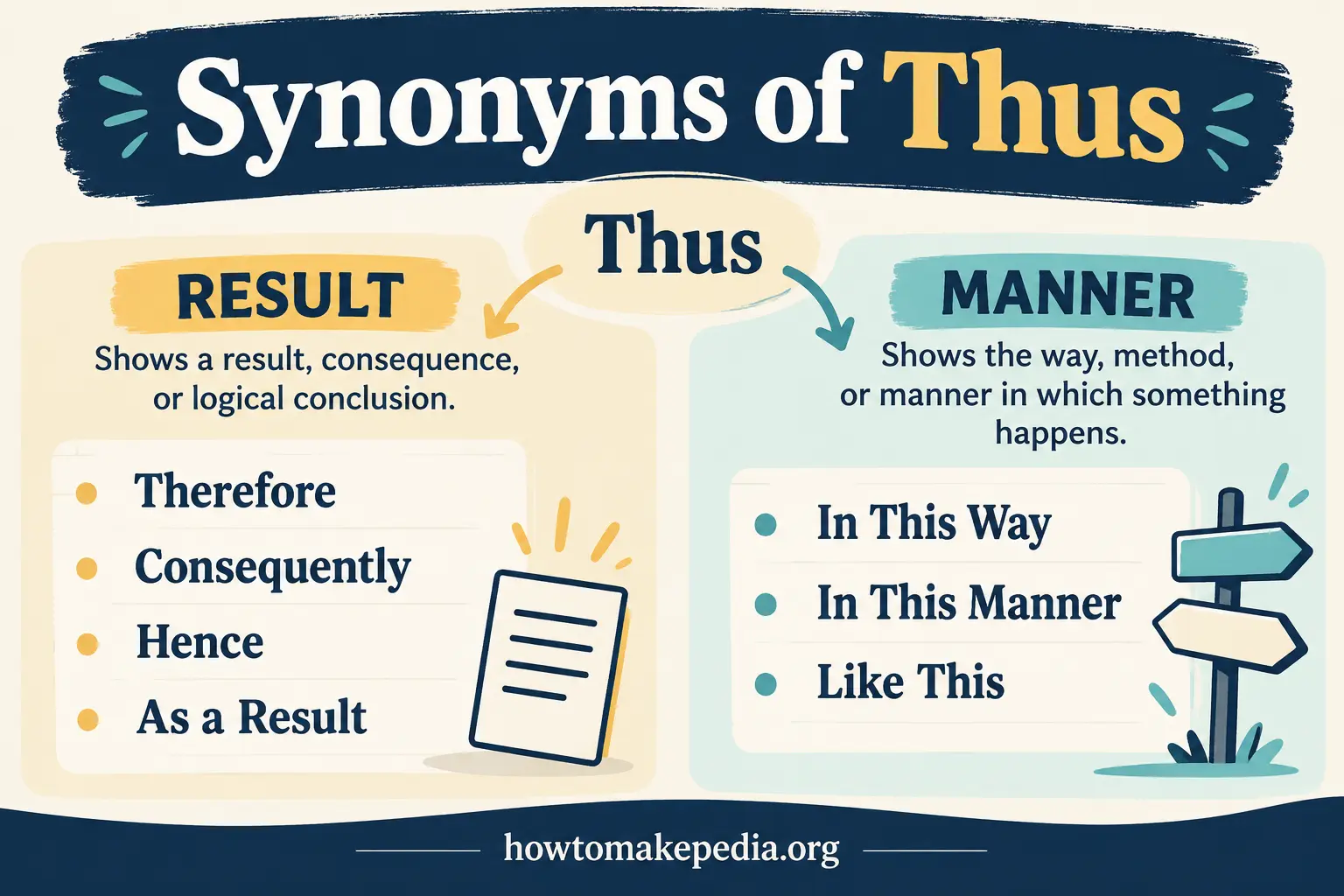

The best synonyms of thus include therefore, consequently, hence, accordingly, as a result, and so. These words help explain a result or conclusion. However, thus can also mean “in this way,” making expressions such as in this manner and like this better alternatives in certain sentences.
Choosing the right replacement depends on what you want to say and how formal your writing needs to be.
What Does Thus Mean?
Thus is an adverb pronounced /ðʌs/. It has two main meanings in English.
1. As a result or therefore: It connects information to a consequence or logical conclusion.
Example: “The instructions were unclear; thus, several employees made mistakes.”
2. In this way or manner: It describes how something happens or is done.
Example: “The technician arranged the cables thus: power cables on one side and data cables on the other.”
The expression thus far has a separate meaning: “so far” or “up to this point.”
Best Synonyms of Thus
The following table provides useful alternatives based on meaning and context.
| Alternative | Meaning | Best Use |
|---|---|---|
| Therefore | For that reason | Logical conclusions |
| Consequently | As a consequence | Cause and effect |
| Hence | For this reason | Formal explanations |
| Accordingly | In response to circumstances | Decisions and actions |
| As a result | Because of what happened | Explaining outcomes |
| For this reason | Because of the stated reason | Explanations |
| For that reason | Because of an earlier fact | Referring back |
| So | Therefore | Everyday conversation |
| It follows that | A conclusion can be drawn | Logical arguments |
| Ergo | Therefore | Scholarly or humorous contexts |
| In this way | By this method | Describing processes |
| In this manner | In this particular way | Formal instructions |
| Like this | In the demonstrated way | Casual instructions |
| By doing so | Through that action | Connecting actions and results |
| By this means | Through this method | Formal descriptions |
These expressions are not interchangeable in every sentence. Some require changes to grammar or sentence structure.
Synonyms of Thus Meaning “Therefore”
When thus introduces a result, these alternatives are especially useful.
Therefore
Therefore introduces a conclusion supported by earlier information.
“The documents were incomplete; therefore, the application was rejected.”
Consequently
Consequently emphasizes what happened because of a previous condition or event.
“The factory experienced a power failure. Consequently, production stopped.”
Hence
Hence is a relatively formal alternative that often appears in academic or analytical writing.
“The sample was too small; hence, the conclusions remain uncertain.”
Accordingly
Accordingly commonly describes a suitable response to circumstances.
“The customer requested a refund. Accordingly, the manager reviewed the transaction.”
As a Result
As a result directly explains an outcome and works well in everyday and professional writing.
“The school introduced additional tutoring. As a result, more students completed their assignments.”
For This Reason / For That Reason
Both expressions refer to a previously stated reason. They are especially helpful when explaining decisions.
“The building requires electrical repairs. For this reason, tomorrow’s classes will be held online.”
So
So is one of the most natural conversational substitutes.
“The meeting ended early, so we went home.”
Unlike thus, so can function as a coordinating conjunction connecting two complete clauses.
Synonyms of Thus Meaning “In This Way”
When thus describes a method, result-related words such as therefore are usually unsuitable.
In this way: “The instructor demonstrated each movement. In this way, beginners learned the routine.”
In this manner: “Position the containers in this manner: large boxes underneath and smaller ones above.”
Like this: “Hold the brush like this, with your fingers close to the tip.”
By doing so: “She labeled every folder. By doing so, she made the records easier to locate.”
By this means: “The researchers collected measurements remotely. By this means, they avoided disturbing the equipment.”
Other context-dependent options include in such a way, which often needs further explanation: “Arrange the chairs in such a way that everyone can see the screen.”
Formal and Informal Alternatives to Thus
Thus generally sounds more formal than everyday expressions such as so.
| Writing Style | Suitable Alternatives |
|---|---|
| Academic | Therefore, hence, consequently |
| Professional | Accordingly, as a result, for this reason |
| Conversational | So, like this, in this way |
Formality also depends on meaning. For example, like this describes manner, while consequently introduces a result. They serve different purposes.
Thus vs. Therefore vs. Hence
All three words can introduce a conclusion.
- Thus: “The figures were inaccurate; thus, the estimate was revised.”
- Therefore: “The evidence was insufficient; therefore, the claim remained unproven.”
- Hence: “The roads were icy; hence, the decision to delay the trip.”
Therefore clearly signals reasoning. Hence often sounds more formal and can also refer to future time, as in “two years hence.”
Only thus among these three commonly describes a manner: “Arrange the materials thus.”
Thus vs. Consequently vs. Accordingly
These words share some uses but emphasize different relationships.
Thus can introduce a general result or inference. Consequently emphasizes a consequence of an earlier event. Accordingly often introduces a reasonable response.
Compare:
- “Sales increased; thus, revenue improved.”
- “Shipping costs rose. Consequently, profits decreased.”
- “The client changed the requirements. Accordingly, the team updated its proposal.”
The last sentence emphasizes a decision made in response to new information.
Thus vs. Thereby
Thereby is related to thus, but it often identifies a result achieved through a particular action.
Thus: “The process was simplified; thus, employees finished sooner.”
Thereby: “The team simplified the process, thereby reducing completion time.”
Thereby commonly works with an action-result construction, rather than replacing every sentence-level use of thus.
What Does Thus Far Mean?
Thus far means so far, until now, or up to this point.
“Thus far, the investigation has uncovered no major problems.”
“The project has remained within budget thus far.”
In suitable contexts, to date is another alternative.
“To date, the company has received 200 applications.”
Unlike standalone thus, the complete expression thus far refers to time, not a logical result.
How to Use Thus Correctly
Punctuation changes according to how thus functions.
At the Beginning of a Sentence
“The initial test failed. Thus, the engineers repeated it.”
A comma commonly follows introductory thus when it connects complete statements.
After a Semicolon
“The road was blocked; thus, the delivery arrived late.”
The semicolon separates two independent clauses connected by the conjunctive adverb thus.
Avoid a Comma Splice
Incorrect: “The road was blocked, thus, the delivery arrived late.”
Correct: “The road was blocked; thus, the delivery arrived late.”
Alternatively, use so with a comma:
“The road was blocked, so the delivery arrived late.”
With an -ing Clause
“The company updated its systems, thus improving security.”
This is grammatically acceptable because “improving security” is not an independent clause.
Within a Sentence
“The company reduced waste and thus lowered operating costs.”
Thus does not always need commas.
For its manner meaning, a colon may introduce an explanation:
“Fold the paper thus: bring the two upper corners together.”
How to Replace Thus in Sentences
These examples show how the meaning and grammar affect your choice.
1. School essay
Original: “The character ignored the warning; thus, the conflict became unavoidable.”
Rewritten: “The character ignored the warning; therefore, the conflict became unavoidable.”
Therefore preserves the logical connection.
2. Academic research
Original: “Several measurements were missing; thus, the results were incomplete.”
Rewritten: “Several measurements were missing. Consequently, the results were incomplete.”
Consequently emphasizes the outcome.
3. Business report
Original: “Operating expenses declined; thus, profitability improved.”
Rewritten: “Operating expenses declined. As a result, profitability improved.”
As a result sounds straightforward and professional.
4. Everyday conversation
Original: “It started raining; thus, we stayed inside.”
Rewritten: “It started raining, so we stayed inside.”
So sounds more conversational and changes the punctuation.
5. Step-by-step instructions
Original: “Arrange the towels thus: place the largest at the bottom.”
Rewritten: “Arrange the towels like this: place the largest at the bottom.”
Like this replaces the manner meaning.
6. Technical explanation
Original: “Connect the components thus: attach the red wire first.”
Rewritten: “Connect the components in this manner: attach the red wire first.”
In this manner preserves the instructional meaning.
7. Project update
Original: “Thus far, the project has met every deadline.”
Rewritten: “So far, the project has met every deadline.”
So far replaces the complete expression thus far.
Common Mistakes With Thus Synonyms
Avoid these errors when choosing another word for thus.
- Henceforth means “from now on,” not “therefore.”
- Thereafter means “after that time,” not necessarily “because of that.”
- Subsequently indicates something happened later; it does not establish causation.
- Thereby often needs a different sentence structure.
- Consequently thus and therefore accordingly are redundant combinations.
- As such is not a universal replacement for thus.
- A result transition should only be used when the preceding information supports that result.
Frequently Asked Questions
What is the best synonym for thus?
Therefore is often the closest replacement when thus introduces a conclusion. For everyday writing, so or as a result may sound more natural. For the manner meaning, use in this way.
Is thus the same as therefore?
They can express similar conclusions, but they are not identical. Thus also describes how something is done, whereas therefore generally introduces a result or logical conclusion.
What is a formal alternative to thus?
Therefore, consequently, hence, and accordingly are useful formal alternatives. Choose consequently for outcomes and accordingly for appropriate responses rather than treating every option as interchangeable.
Can I use so instead of thus?
Yes, when thus expresses a result. However, the sentence may need different punctuation. For example, “It was late; thus, we left” becomes “It was late, so we left.”
What does thus far mean?
Thus far means “so far” or “up to this point.” It refers to a period continuing to the present or another stated point, rather than introducing a conclusion.
Conclusion
The most useful synonyms of thus depend on the intended meaning. Therefore, consequently, hence, and as a result commonly express conclusions or outcomes. In this way, in this manner, and like this describe methods. Before replacing thus, check the relationship between your ideas, the tone, and the sentence’s grammar.
