
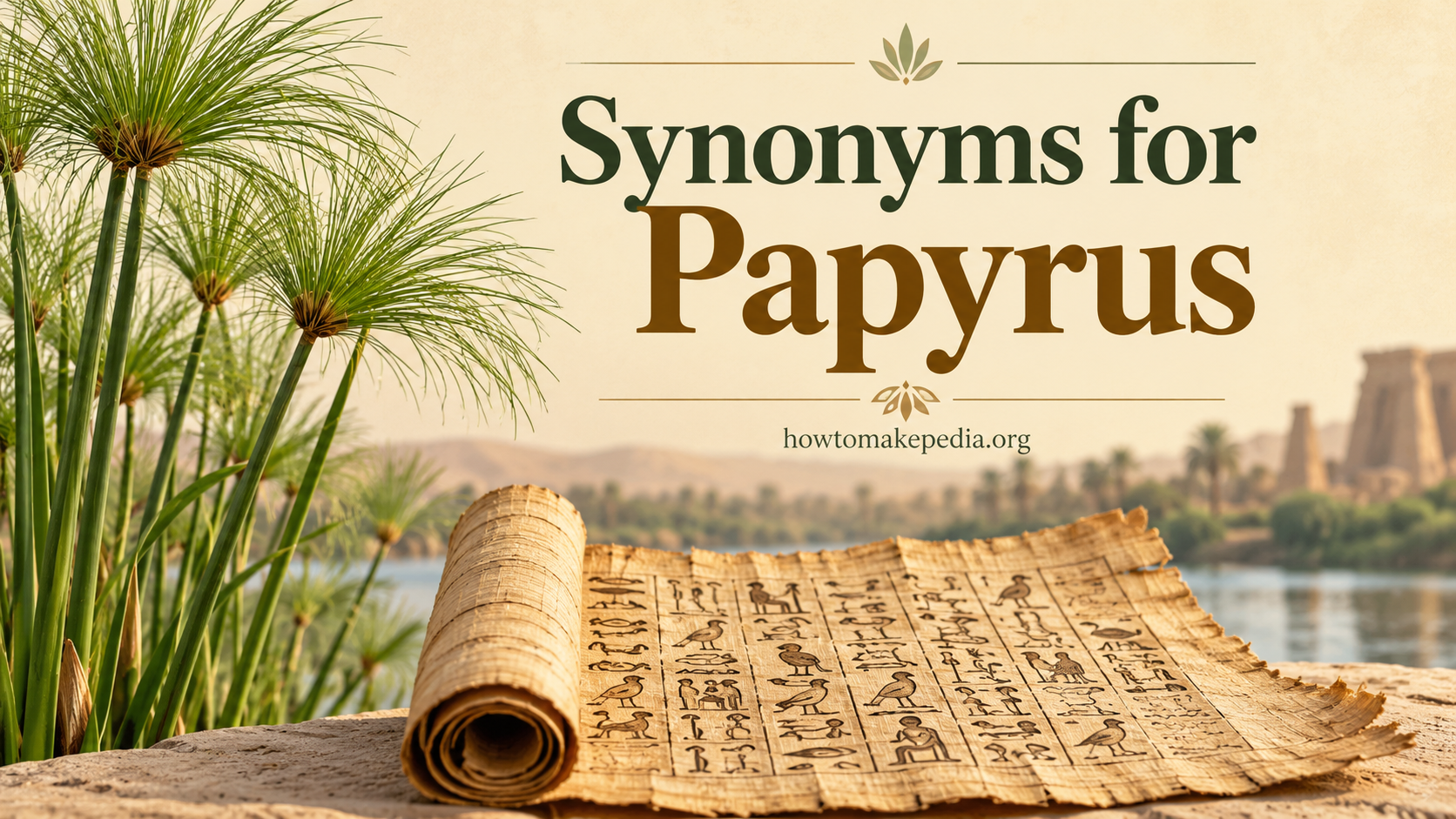

Synonyms for papyrus depend on whether you mean the ancient writing material, the plant used to make it, or a document written on it. Paper reed, papyrus sedge, and Egyptian paper reed are alternative names for the plant. Words such as parchment, scroll, and manuscript are related to papyrus, but they are not exact synonyms.
What Does Papyrus Mean?
Papyrus is a noun with three main meanings.
- Papyrus plant: A tall, grasslike plant that grows in wetlands, especially in parts of Africa.
- Papyrus writing material: A material ancient Egyptians made from the inner stems of the papyrus plant and used for writing.
- Papyrus document: An individual written document or piece of writing preserved on papyrus.
For example, “The museum displayed an ancient papyrus containing a letter” uses papyrus to mean a document.
Pronunciation: /pəˈpaɪ.rəs/ (puh-PIE-russ)
Plural: Papyri or papyruses. The form papyri is especially common when discussing historical documents.
The meaning of papyrus changes with context, so choosing another word requires understanding what the original sentence describes.
What Are the Synonyms for Papyrus?
Papyrus has relatively few close equivalents. Some terms identify the same plant, while others describe the material or documents made from it.
| Word or Phrase | Meaning | Relationship | Can It Replace Papyrus? |
|---|---|---|---|
| Paper reed | Common name for the papyrus plant | Close plant alternative | Yes, for the plant |
| Papyrus sedge | Name identifying the plant as a sedge | Close plant alternative | Yes, for the plant |
| Egyptian paper reed | Another common plant name | Close plant alternative | Yes, for the plant |
| Cyperus papyrus | Scientific species name | Botanical name | Yes, in botanical writing |
| Papyrus paper | Writing material made from papyrus | Descriptive phrase | Often, for the material |
| Papyrus document | Writing preserved on papyrus | Specific description | Yes, for a document |
| Paper | General writing material | Broad term | Only when precision is unnecessary |
Important: A phrase describing papyrus is not necessarily an independent dictionary synonym. For historical writing, the original word is often the most accurate choice.
Alternative Names for the Papyrus Plant
The papyrus plant has the scientific name Cyperus papyrus. It belongs to the sedge family, Cyperaceae.
Common names include:
- Paper reed: A recognized name for the papyrus plant.
- Papyrus sedge: A name emphasizing its botanical family.
- Egyptian paper reed: A plant name connected with its historical use in Egypt.
- Nile grass: Another common name, although the plant is botanically a sedge rather than a true grass.
- Paper plant: A common name that requires context because it can be ambiguous.
Papyrus grows in wet environments and produces tall stems topped with spreading clusters of slender branches.
Although people sometimes describe papyrus as a reed, not every reed is papyrus. Similarly, sedge refers to a much broader plant family.
Use Cyperus papyrus when scientific precision matters.
Several words belong to the same vocabulary group as papyrus without having identical meanings.
Paper: A broad name for writing and printing materials. Modern paper is generally made from processed fibers, unlike traditional papyrus sheets.
Papyrus paper: A useful descriptive phrase that identifies the historical plant-based material.
Writing material: A general expression for a surface used to record information.
Writing sheet: A flat piece prepared for writing. It describes a form rather than identifying what the sheet contains.
Parchment: A writing material produced from specially prepared animal skin.
Vellum: A type or quality of parchment traditionally associated with calfskin. The word is also used more broadly for fine parchment.
These words are useful when discussing the development of writing, but they should not automatically replace papyrus.
Papyrus documents can take different forms and contain different types of information.
| Related Word | Meaning | Classification |
|---|---|---|
| Manuscript | A handwritten document or original written work | Document type |
| Scroll | A document arranged in a roll | Document format |
| Codex | A book constructed with bound leaves | Book format |
| Document | Written or recorded information | Broad term |
| Historical record | Evidence or information preserved from the past | Document description |
| Folio | A leaf in a manuscript or book | Book terminology |
| Inscription | Words written or engraved on a surface | Writing terminology |
| Tablet | A solid writing surface, such as clay or wax-coated wood | Different writing support |
A manuscript may be written on papyrus, parchment, or paper. Likewise, a scroll may consist of papyrus sheets, but the word scroll does not identify its material.
Terms such as ledger, memo, and archive are even less suitable as substitutes because they describe particular records or collections rather than papyrus itself.
Papyrus vs. Parchment vs. Vellum
These three historical materials share a practical purpose, but their origins differ.
| Material | Made From | Historical Use | Same as Papyrus? |
|---|---|---|---|
| Papyrus | Inner stem material of the papyrus plant | Letters, records, and literary texts | Yes |
| Parchment | Prepared animal skin | Manuscripts, records, and books | No |
| Vellum | Traditionally fine parchment, often associated with calfskin | Manuscripts and documents | No |
Papyrus vs. parchment: Papyrus is plant-derived, while parchment is animal-derived.
Papyrus vs. vellum: Vellum belongs to the parchment family, not to the papyrus family.
Parchment vs. vellum: These words sometimes overlap in historical and conservation terminology, although vellum may identify a particular type of parchment.
All three materials could support writing, but their names should not be used interchangeably.
Papyrus vs. Paper, Scroll, and Manuscript
The differences become easier to understand when you identify whether a word describes a material, a physical format, or a written work.
Papyrus vs. Paper
Papyrus sheets were traditionally made by arranging strips of plant stem material in crossing layers, then pressing and drying them.
Modern paper generally consists of processed plant fibers formed into sheets.
Both support writing, but their manufacturing methods differ.
Papyrus vs. Scroll
Papyrus describes a plant, material, or document. A scroll describes a rolled document.
Accurate: The ancient scroll was made from papyrus.
Less precise: The ancient scroll was made from scroll.
The first sentence distinguishes the material from the format.
Papyrus vs. Manuscript
A manuscript is identified by the nature of the written work, not by a single writing material.
A handwritten letter on papyrus can be both a manuscript and a papyrus document. However, a manuscript written on parchment is not papyrus.
A codex, meanwhile, describes a booklike arrangement of leaves. Ancient codices could contain different writing materials, including papyrus.
These original examples show how the words work in natural English.
- Papyrus: Ancient Egyptian scribes used papyrus to preserve written information.
- Papyrus plant: The papyrus plant flourished beside the shallow water.
- Papyrus paper: The artist demonstrated how strips of plant material could form papyrus paper.
- Papyri: Researchers carefully examined several damaged papyri.
- Scroll: The museum displayed a papyrus scroll inside a protective case.
- Manuscript: The historian studied a handwritten manuscript from an ancient collection.
- Parchment: The conservator handled the parchment document with great care.
- Vellum: The illuminated manuscript contained pages of fine vellum.
- Cyperus papyrus: The botanical garden identified the tall wetland plant as Cyperus papyrus.
- Sedge: Our teacher explained that papyrus is a sedge rather than a true grass.
Notice that each word provides a different piece of information. Replacing one with another can change the meaning of a sentence.
How to Choose the Right Word Instead of Papyrus
Before using another word, ask what you want to describe.
For the living plant: Choose paper reed, papyrus sedge, or Cyperus papyrus.
For the writing material: Use papyrus or the descriptive phrase papyrus paper.
For a historical document: Use papyrus document when the material is important.
For the document’s form: Use scroll, manuscript, or codex only when the form or type matches.
Consider these examples:
- Original: The museum preserved a papyrus.
- Clearer: The museum preserved a papyrus manuscript containing an ancient letter.
And:
- Original: Papyrus grew beside the river.
- Alternative: Paper reed grew beside the river.
The second replacement works because both expressions refer to the same plant.
Common Mistakes About Papyrus Synonyms
Writers should avoid several common vocabulary errors.
- Calling parchment and papyrus identical materials.
- Assuming every ancient scroll was made from papyrus.
- Treating every handwritten manuscript as a papyrus document.
- Using sedge as though it identified only one plant species.
- Calling a codex a material instead of a book format.
- Treating words such as memo, tablet, or archive as exact synonyms.
- Assuming ancient papyrus and modern paper were manufactured in the same way.
Another common mistake is treating papyri as a separate synonym. It is simply a plural form of papyrus.
Practice Exercise: Choose the Correct Word
Choose the best answer from these words: Papyrus, Parchment, Scroll, Manuscript, Sedge.
- Papyrus belongs to a family of plants commonly known as ______.
- Ancient Egyptians made writing sheets from the stems of ______.
- A historical writing surface made from prepared animal skin is ______.
- The curator carefully unrolled the long ______ to examine its writing.
- A handwritten work, whether preserved on paper or another material, is a ______.
Answers
- Sedge: Papyrus belongs to the sedge family.
- Papyrus: Its stems supplied the writing material.
- Parchment: It is traditionally made from animal skin.
- Scroll: This describes the rolled document format.
- Manuscript: The term describes a handwritten work.
Frequently Asked Questions
What is another word for papyrus?
For the plant, paper reed, papyrus sedge, and Egyptian paper reed are useful alternative names. For the writing material, papyrus paper is a descriptive expression.
Is parchment a synonym for papyrus?
No. Parchment is made from prepared animal skin, whereas papyrus is made from plant material. Both were used historically for writing.
Is papyrus the same as modern paper?
No. Papyrus sheets are assembled from strips of plant stem material. Modern paper generally uses processed fibers. Their uses overlap, but their structures and production methods differ.
What is the scientific name of the papyrus plant?
The accepted scientific name is Cyperus papyrus. The species belongs to the sedge family, Cyperaceae.
What is the plural of papyrus?
Both papyri and papyruses are accepted plural forms. Papyri is especially familiar in historical and scholarly discussions of ancient documents.
Can a scroll be made from papyrus?
Yes. Papyrus sheets could be joined into rolls. However, scrolls were also made from other materials, including parchment.
Conclusion
The best synonyms for papyrus depend on the intended meaning. Paper reed, papyrus sedge, and Egyptian paper reed can identify the plant, while papyrus paper describes the writing material. Words such as parchment, scroll, manuscript, and codex are related but have distinct meanings.
Choosing the most precise term makes vocabulary explanations clearer and historical descriptions more accurate.
