
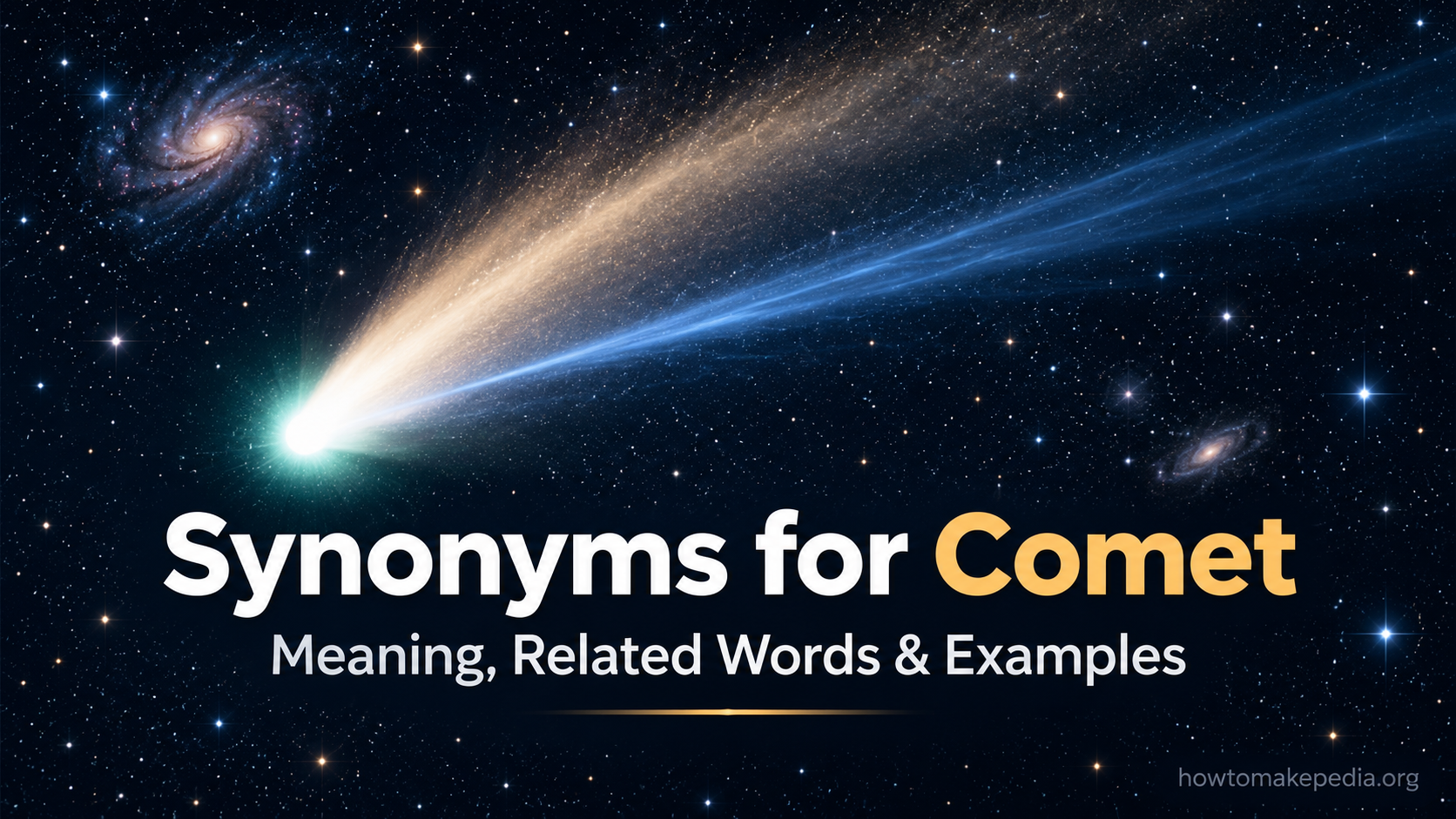

Synonyms for comet include descriptive names such as dirty snowball, icy dirtball, and dirty iceberg. Writers can also use poetic phrases like celestial wanderer, cosmic snowball, and tailed visitor. However, these are not exact dictionary synonyms. Their meanings depend on context, and a shooting star is not the same thing as a comet.
What Does Comet Mean?
A comet is a small celestial body containing frozen gases, dust, and rocky material. Most familiar comets orbit the Sun, although interstellar comets can enter our solar system from elsewhere.
Pronunciation: /ˈkɑː.mɪt/ (American English)
Simple meaning: An icy object in space that may develop a glowing cloud and visible tails when warmed by the Sun.
A comet has a solid center called its nucleus. When sunlight warms its frozen material, gas and dust can escape, forming a surrounding cloud called a coma. Sunlight and the solar wind may then create dust and ion tails.
Not every comet has a visible tail. Some remain faint or relatively inactive when they are far from the Sun.
For scientific explanations, see NASA’s comet facts.
What Are the Best Synonyms for Comet?
The following alternatives describe comets in different ways. None should automatically replace comet in every sentence.
| Word or Phrase | Classification | Best Context |
|---|---|---|
| Dirty snowball | Established nickname | Astronomy education |
| Icy dirtball | Informal nickname | Comet composition |
| Dirty iceberg | Scientific analogy | Comet nuclei |
| Small icy body | Broad description | Science writing |
| Celestial body | General category | Formal explanations |
| Cosmic snowball | Creative metaphor | Informal writing |
| Celestial wanderer | Poetic expression | Literature |
| Tailed visitor | Creative description | Storytelling |
| Long-haired star | Historical expression | History of astronomy |
The most reliable option depends on whether you are explaining the science or describing a comet creatively.
Common Names and Descriptions for Comets
These expressions are useful for educational writing. The first three have documented connections to astronomy; the remaining terms are broader descriptions.
1. Dirty Snowball
Meaning: A familiar nickname comparing a comet’s icy, dusty nucleus to a snowball containing dirt.
Example: Our science teacher explained why comets are sometimes called dirty snowballs.
Best use: Informal astronomy lessons. It is not a formal scientific name.
2. Icy Dirtball
Meaning: An alternative nickname emphasizing the mixture of rocky or dusty material and frozen substances.
Example: The spacecraft collected information about the comet’s icy dirtball-like nucleus.
Best use: Explaining comet composition informally.
3. Dirty Iceberg
Meaning: An analogy comparing the solid nucleus of a comet to an iceberg mixed with darker material.
Example: The astronomer compared the comet’s nucleus to a dirty iceberg.
Best use: Describing the nucleus rather than the entire active comet.
4. Small Icy Body
Meaning: A general description of a relatively small object containing ice.
Example: The telescope detected a small icy body in the outer solar system.
Best use: Scientific explanations. Other objects may also fit this description.
5. Celestial Body
Meaning: A natural object in space, including planets, moons, asteroids, and comets.
Example: The class studied a celestial body identified as a comet.
Best use: Formal writing when the object’s identity is already clear.
6. Astronomical Object
Meaning: A general term for an object studied in astronomy.
Example: Researchers observed an unusual astronomical object with a growing coma.
Best use: Scientific reports. This phrase is much broader than comet.
7. Small Solar System Body
Meaning: A category covering many smaller objects in our solar system, including comets.
Example: Astronomers classified the comet as a small solar system body.
Best use: Technical discussions of objects belonging to our solar system.
8. Interstellar Visitor
Meaning: An object arriving from beyond our solar system.
Example: Scientists identified the interstellar visitor as a comet originating outside our solar system.
Best use: Discussions of interstellar comets only, not ordinary solar system comets.
Poetic and Creative Ways to Describe a Comet
These seven expressions are literary descriptions, not established dictionary synonyms. They are appropriate when the context makes it clear that you mean a comet.
9. Cosmic Snowball
Meaning: A playful comparison emphasizing a comet’s frozen material.
Example: The young explorer imagined a cosmic snowball drifting through the darkness.
Best use: Children’s stories and imaginative science writing.
10. Celestial Wanderer
Meaning: A poetic description of an object traveling through space.
Example: The celestial wanderer slowly changed its position among the distant stars.
Best use: Poetry and descriptive essays.
11. Tailed Visitor
Meaning: A comet described through its distinctive visible tail.
Example: The tailed visitor became brighter as it approached the Sun.
Best use: Stories about an active, tailed comet.
12. Icy Traveler
Meaning: A creative description emphasizing the cold materials within a comet.
Example: The icy traveler carried ancient material through space.
Best use: Educational storytelling and fiction.
13. Glowing Visitor
Meaning: A poetic name for a comet whose coma or tails make it appear luminous.
Example: The glowing visitor remained visible through the telescope for several nights.
Best use: Atmospheric descriptions of bright comets.
14. Ribbon-Tailed Traveler
Meaning: An imaginative description of a comet with a long, graceful-looking tail.
Example: A ribbon-tailed traveler appeared above the distant mountain range.
Best use: Poetry and visual descriptions, not scientific reports.
15. Frozen Time Capsule
Meaning: A metaphor suggesting that comets preserve materials from ancient stages of planetary-system formation.
Example: The scientist called the comet a frozen time capsule containing clues about the distant past.
Best use: Science-inspired writing. This describes a comet’s significance, not its formal identity.
Historical Names for Comets
The word comet comes through Latin from Greek komētēs, associated with long hair. Ancient observers compared a comet’s appearance to hair extending from a bright object.
16. Long-Haired Star
Meaning: A historically attested description reflecting the hairlike appearance of some comets.
Example: Ancient writers used imagery resembling a long-haired star to describe a comet.
Classification: Historical expression.
17. Tailed Star
Meaning: A traditional appearance-based description of a comet with a visible tail.
Example: The old illustration showed a tailed star above the town.
Classification: Traditional or historical description.
Important: Neither expression means that a comet is physically a star. Modern astronomy identifies comets as a separate class of celestial objects.
Comet vs. Meteor vs. Asteroid vs. Shooting Star
These astronomy terms refer to different objects or phenomena.
| Term | Correct Meaning |
|---|---|
| Comet | An icy body that may develop a coma and tails |
| Asteroid | A small body generally dominated by rocky or metallic material |
| Meteoroid | A small natural particle or fragment traveling through space |
| Meteor | Light produced when material enters an atmosphere |
| Meteorite | Material that survives atmospheric entry and reaches the ground |
| Shooting star | An informal name for a meteor |
| Fireball | An exceptionally bright meteor |
A comet can be visible over multiple nights, with its apparent position changing gradually. A meteor usually appears as a brief streak of light.
Although meteoroids sometimes originate from comets, the resulting meteors are not comets themselves.
NASA explains these distinctions in its guide to asteroids, meteors, and comets.
Why Is a Comet Called a Dirty Snowball?
The nickname dirty snowball comes from a comet’s mixture of frozen substances, dust, and rocky material.
The snowball part refers to ice, while dirty refers to the non-ice material mixed into the nucleus.
It is a helpful introductory comparison, but comets are not ordinary snowballs. Their surfaces, structures, and composition vary, and some nuclei contain substantial amounts of dust and rock.
Comet Vocabulary: Nucleus, Coma, and Tail
These words describe comet structures and behavior rather than synonyms for the entire object.
- Nucleus: The solid central portion containing ice, dust, and rocky material.
- Coma: The cloud of gas and dust surrounding an active comet’s nucleus.
- Dust tail: Dust particles carried away by solar radiation, often forming a curved tail.
- Ion tail: Electrically charged gas affected by the solar wind, generally pointing directly away from the Sun.
- Orbit: The path an object follows under gravity.
- Periodic comet: A comet that returns on a repeating orbit.
- Interstellar comet: A comet originating outside our solar system and passing through it.
A comet’s tail is not a stream of flames. It generally extends away from the Sun rather than simply following behind the comet’s direction of travel.
These original sentences show how different expressions work in everyday, educational, and creative contexts.
- The students learned that a comet contains ice, dust, and rocky material.
- Astronomers photographed a bright comet through a powerful telescope.
- Our teacher used the phrase dirty snowball to explain comet composition.
- The celestial body developed a coma as it approached the Sun.
- The icy traveler carried ancient material through space.
- In the story, a celestial wanderer appeared above the quiet ocean.
- The tailed visitor remained in the evening sky for several nights.
- Scientists examined the nucleus of the small icy body.
- The poet compared the comet to a ribbon-tailed traveler.
- The museum explained why ancient people imagined a long-haired star.
For school assignments, use comet when scientific identification matters. Choose poetic expressions when imagination and atmosphere are more important.
Common Mistakes About Comet Synonyms
Several mistakes can make comet vocabulary confusing:
- Calling a shooting star or fireball a comet.
- Describing a comet’s tail as actual fire.
- Assuming every comet always has a visible tail.
- Treating the nucleus or coma as a synonym for the whole comet.
- Describing comets as real stars.
- Presenting poetic phrases as official astronomy terminology.
- Treating broad labels such as celestial body as exact synonyms.
These distinctions help keep both scientific and creative writing clear.
How to Choose the Right Word for Comet
Use comet in astronomy reports, definitions, and scientific assignments. It is usually the most precise word.
Use dirty snowball when explaining composition to beginners. Choose celestial body only when a broader term is appropriate.
For poetry, a phrase such as celestial wanderer can add atmosphere without pretending to be a scientific classification.
Scientific: The comet developed a dust tail as it approached the Sun.
Creative: The celestial wanderer displayed a pale ribbon of dust against the night sky.
Both sentences work because their wording matches their purpose.
Frequently Asked Questions
What is another word for comet?
Dirty snowball is a widely recognized descriptive nickname. Celestial wanderer and tailed visitor are creative alternatives, while celestial body is a broad category.
Does comet have an exact synonym?
There is no widely used single-word English synonym that matches comet precisely in every scientific context. Descriptive alternatives are generally more useful than supposed direct replacements.
Is a shooting star a comet?
No. A shooting star is a meteor: a brief luminous phenomenon produced when space material enters an atmosphere. A comet is an icy celestial body traveling through space.
What is a poetic name for a comet?
Celestial wanderer, glowing visitor, and ribbon-tailed traveler can work in poetry. They are creative expressions rather than standardized names.
Is an asteroid the same as a comet?
No. Asteroids are generally dominated by rocky or metallic material, while comets are known for containing frozen substances that can produce gas and dust activity. Some unusual objects blur the distinction.
Can all comets be seen from Earth?
No. Many comets are too faint or distant to see without specialized equipment. Even visible comets do not necessarily develop dramatic tails.
Conclusion
The best synonyms for comet are usually descriptive nicknames, broad astronomical terms, or creative expressions rather than exact word replacements. Dirty snowball works for informal science explanations, while celestial wanderer suits poetry. Understanding these differences helps you choose accurate, natural language without confusing comets with meteors, asteroids, or stars.
